Table of Contents
Why LinkedIn Is the #1 B2B Lead Gen Platform in 2025
Step 1: Optimize Your LinkedIn Presence for Lead Generation
Step 2: Build a Strategic Connection Network
Step 3: Using Content to Attract B2B Leads on LinkedIn
Step 4: Implement a Systematic Outreach Campaign
Step 5: Measure, Analyze, and Optimize Your LinkedIn Lead Generation
Bringing It All Together: Your LinkedIn Lead Generation Action Plan
When to Consider Outsourcing Your LinkedIn Lead Generation
Conclusion: Taking the Next Step in Your LinkedIn Lead Generation Journey
Frequently Asked Questions
Modified On :
September 25, 2026
Key Takeaways
- LinkedIn remains the #1 platform for B2B lead generation, especially among senior decision-makers.
- Optimize your profile to speak directly to your ideal client’s pain points.
- Grow your network intentionally — focus on prospects, referrals, and industry leaders.
- Post consistently with high-value content (carousels, polls, insights) to build authority.
- Use 4-step outreach sequences that offer value before asking for anything.
- Track what matters: pipeline and conversions, not just likes or follower counts.
Want to skip the guesswork? Cleverly builds and runs this proven system for you.
LinkedIn has become one of the most powerful platforms for B2B lead generation—with over 1 billion members and 69 million companies, the opportunities are massive. But for many businesses, turning that potential into a steady stream of qualified leads remains a challenge.
The good news? Success on LinkedIn doesn’t come from spending more time—it comes from having a smarter, more strategic approach.
After working with hundreds of B2B companies, we’ve developed a proven 5-step playbook that helps transform LinkedIn from a digital brochure into a predictable lead-generation engine.
Whether you're a founder, marketer, or agency leader, this guide will show you how to cut through the noise and generate high-quality B2B leads—without needing to be a LinkedIn expert.
Let’s dive in.
Why LinkedIn Is the #1 B2B Lead Gen Platform in 2025
LinkedIn has evolved into the most effective platform for B2B lead generation—thanks to its massive user base, professional focus, and unmatched targeting capabilities.
With over 1 billion members and 180M+ decision-makers using it to research vendors, LinkedIn offers a rare opportunity: a business-focused environment where your prospects are already in buying mode.
Unlike other social platforms, LinkedIn supports the full B2B funnel—from awareness to conversion—making it the ideal space to build relationships and generate high-quality leads.
Let’s start by optimizing your presence.
Step 1: Optimize Your LinkedIn Presence for Lead Generation
When Carlos started reaching out to prospects on LinkedIn, his response rate hovered around 3%.
Frustrated, he asked a colleague to review his profile. "Your profile reads like a resume, not a resource," she told him bluntly. After spending a weekend transforming his profile to speak directly to his prospects' challenges, his response rate jumped to 21% overnight.
This transformation illustrates a fundamental truth about LinkedIn lead generation: optimization precedes conversation.
The psychology behind this is powerful.
Business professionals form initial impressions within seconds of viewing a LinkedIn profile. In that brief window, they're making snap judgments about your credibility, relevance to their needs, and whether you're worth their limited attention.
Your profile isn't just introducing you; it's actively pre-qualifying (or disqualifying) you for meaningful business conversations.
Most LinkedIn users make the critical mistake of approaching their profile as a digital resume—a backward-looking document that catalogs achievements and responsibilities.
But for lead generation, your profile needs to function as a forward-looking resource that positions you as the guide to solving specific problems your prospects currently face.
Instead of telling prospects how impressive you are, you're showing them how well you understand their world and challenges. This immediately differentiates you from the sea of self-focused professionals vying for their attention.
To implement this approach effectively, we need to focus on two key areas:
- Your personal profile
- Your company page
Let's start with creating a client-focused company presence that serves as a valuable destination rather than a digital brochure.
Creating a Client-Focused Company Page
Most company pages on LinkedIn read like boring corporate brochures, talking endlessly about "who we are" and "what we do" without addressing the one question that matters to prospects: "What's in it for me?"
Instead of "We're an industry-leading provider of innovative solutions," try lead with "We help [specific client type] solve [specific painful problem] to achieve [specific valuable outcome]."
This subtle but powerful reframing immediately signals to visitors that you understand their world—creating an instant connection that generic corporate language never achieves.
For your company page to convert visitors into leads, make sure it includes these essential elements:
- A banner image that visually communicates client outcomes, not your office or team
- A clear, benefit-focused description that states exactly who you help and how
- Featured content that demonstrates thought leadership on topics your prospects care about
- Client success stories prominently displayed (ideally with specific results)
- Regular posts that offer value rather than just company announcements
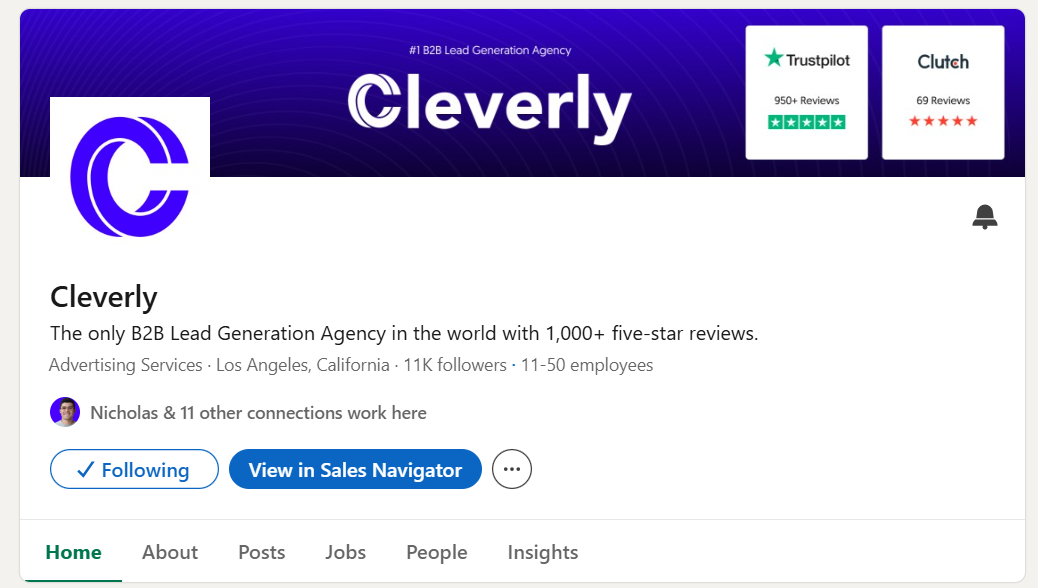
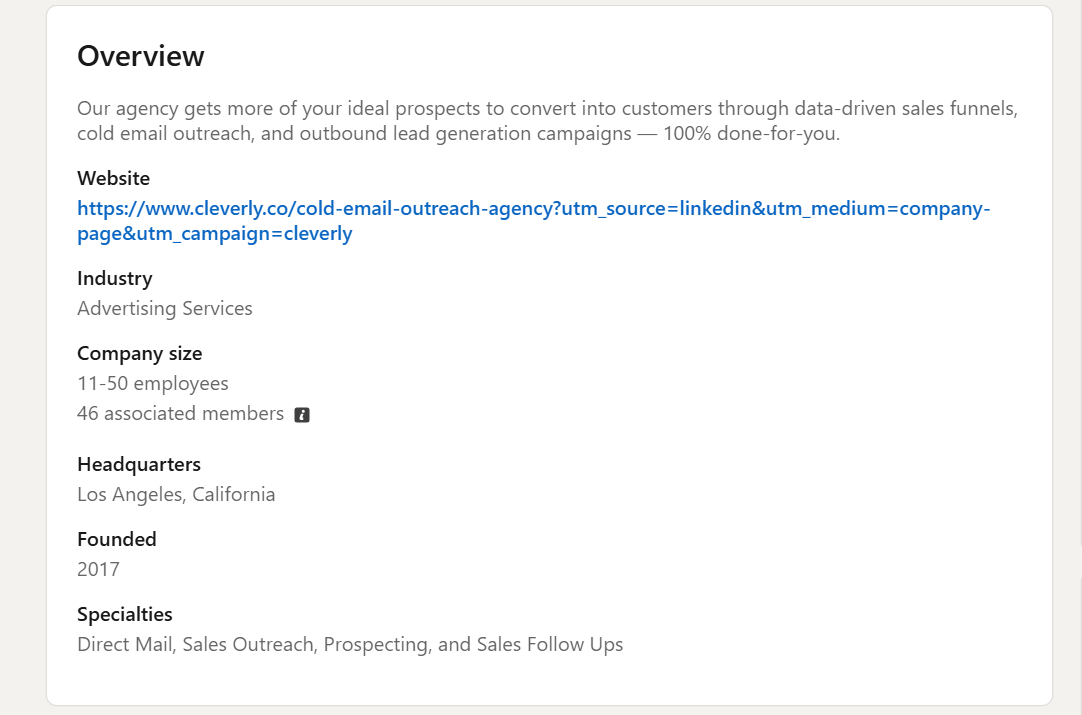
The companies seeing the highest conversion rates from their LinkedIn pages have abandoned corporate-speak entirely. They've embraced a direct, conversational tone that makes prospects feel understood rather than marketed to.
While optimizing company pages across team members requires coordination, this is where clients working with Cleverly experience a distinct advantage—ensuring brand messaging consistency across personal and company profiles without requiring extensive internal resources.
Optimizing Individual Profiles for Sales Conversations
Your personal profile is where the real magic happens on LinkedIn. While company pages build broader awareness, individual profiles drive conversations that convert to opportunities.
The trust signals that transform a profile from forgettable to compelling aren't what most people think. It's not about impressive titles or ivy league education—it's about demonstrating relevance to your prospects' specific challenges.
The most effective profiles incorporate subtle conversation starters—elements that naturally prompt prospects to engage. These include:
- Mentioning specific questions you help clients answer
- Addressing common misconceptions in your industry
- Highlighting counterintuitive results you've achieved
- Referencing timely industry challenges your prospects are likely facing
Headline formula: Your headline is particularly crucial—it's your first impression and follows you everywhere on the platform. Rather than just the default current job title, add a catchy one-liner about your business.
Or, you can use this formula that consistently outperforms traditional headlines: "I help [specific target client] achieve [specific desirable outcome] through [your unique approach]"

About section: Finally, transform your about section from a resume summary into a client-focused narrative using this proven structure:
- Open with a compelling challenge your clients typically face
- Bridge to how you discovered/developed a solution
- Briefly explain your approach and what makes it different
- Provide proof through specific results for clients
- End with a clear call to action that feels like a natural next step

With your LinkedIn presence optimized to attract and engage prospects, the foundation of your lead generation system is in place.
Now it's time to build the network that will fuel your pipeline.
🔗 Turn LinkedIn Into Leads
Cleverly’s done-for-you LinkedIn outreach helps 10,000+ businesses connect with qualified B2B prospects and generate consistent leads.
Step 2: Build a Strategic Connection Network
Imagine your LinkedIn network as a thriving business ecosystem rather than a random collection of profiles.
Many professionals start out by accepting every connection request and even go on connection sprees just to grow their network. It seems like a good idea—more connections mean more reach, right?
But over time, it becomes clear that this approach often leads to a cluttered network filled with people who aren’t ideal clients, can’t refer ideal clients, and simply add noise. As a result, the real prospects—the ones who actually matter—get buried.
This perfectly sums up the ongoing challenge on LinkedIn: quality vs. quantity. Yes, LinkedIn tends to reward larger networks with more visibility.
But if your network isn’t relevant, you might get a lot of engagement… without any real opportunities.
Each connection should serve a specific purpose in your lead generation ecosystem—whether as a potential client, a valuable referral source, or an industry influencer who can amplify your message.
This selective approach creates a powerful network effect.
When your network consists primarily of ideal clients and relevant industry professionals, every piece of content you share reaches more of the right people. Each engagement attracts similar connections, creating a self-reinforcing cycle that continuously improves your lead generation results without requiring more effort.
To build this kind of strategic network, you need to start with clearly identifying your ideal prospects.
Identifying Your Ideal Prospects on LinkedIn
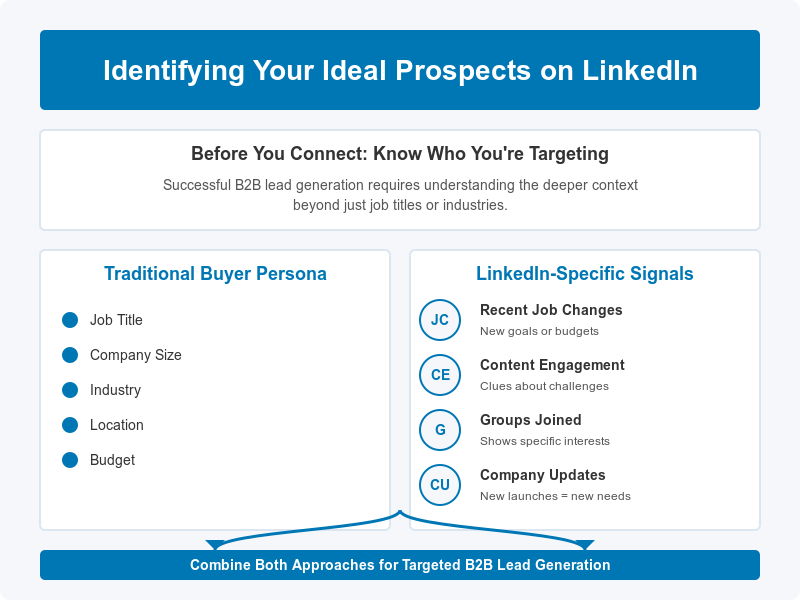
Before you start sending out connection requests, it’s super important to know exactly who you’re trying to reach. And no—it’s not just about job titles or industries.
To really succeed with LinkedIn B2B lead generation, you need to understand the deeper context behind your ideal customer. What are they dealing with right now? What would make them interested in your solution?
The best way to do this is to mix your regular buyer persona info (like job title, company size, and industry) with what LinkedIn uniquely offers. Look out for things like:
- Recent job changes – They may have new goals or budgets.
- Content they engage with – Gives you clues about their challenges.
- Groups they’ve joined – Shows specific interests.
- Company updates – New launches or changes often mean new needs.
LinkedIn’s search filters and Boolean search tricks (like using AND, OR, and NOT) help you find exactly the right kind of decision-makers.
For example, you can search for people who are “VP of Marketing” AND work in SaaS but NOT in agencies—super targeted!
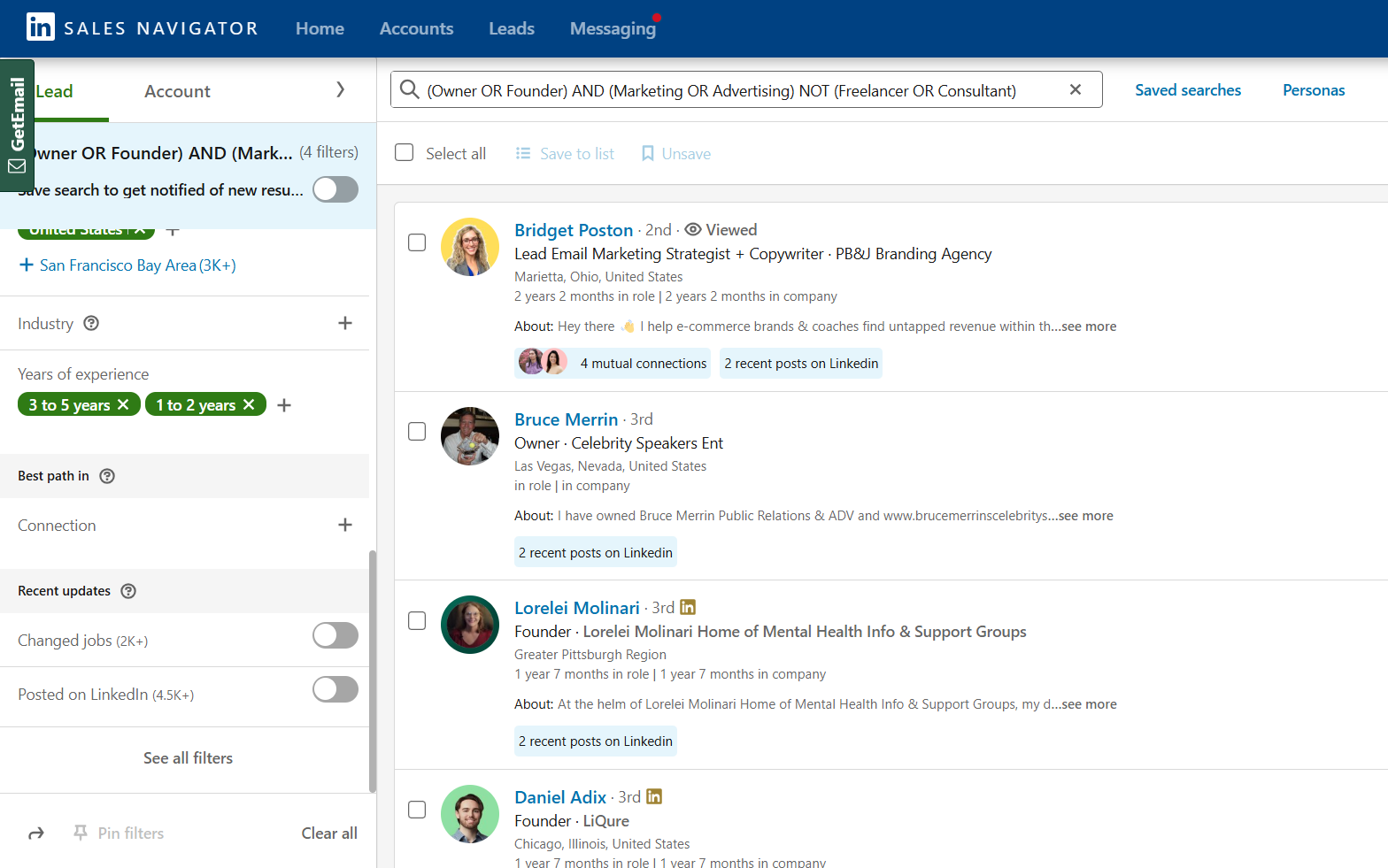
Another smart move? Mapping out who’s involved in the buying process inside your target companies. Most B2B deals aren’t made by one person—they involve teams. LinkedIn gives you a peek into these networks so you can connect with the right people.
And if this sounds like a lot of manual work, don’t worry. Cleverly makes it easy by helping you target the right people at scale—without spending hours doing it all by hand.
Connection Request Strategies That Convert
The humble connection request represents your first impression and sets the tone for your entire relationship. Yet most professionals squander this opportunity with generic "I'd like to add you to my network" requests that give prospects zero reason to accept.
Understanding the psychology of acceptance dramatically improves your results.
LinkedIn users accept connection requests based on three primary factors:
- Perceived relevance,
- Potential value,
- And personal safety (will this person spam me?)
A high-converting connection request addresses all three factors in just 2-3 sentences. The formula that consistently achieves 70%+ acceptance rates includes:
- A specific reason for connecting that feels natural, not forced
- A subtle value indicator that suggests mutual benefit
- A personal touch that shows you're a real human, not a bot
For example: "Hi Sarah, I noticed your comment about marketing automation challenges in the B2B Marketing group. I've been working on some effective approaches to this problem with companies similar to yours. Thought connecting might be mutually beneficial."
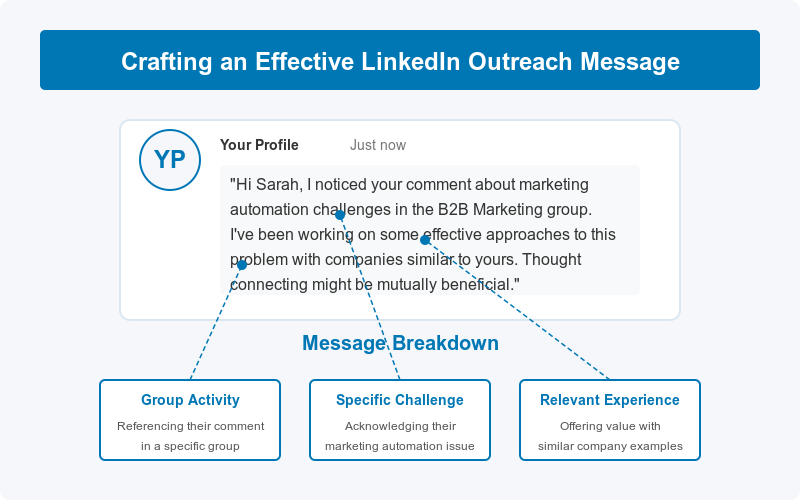
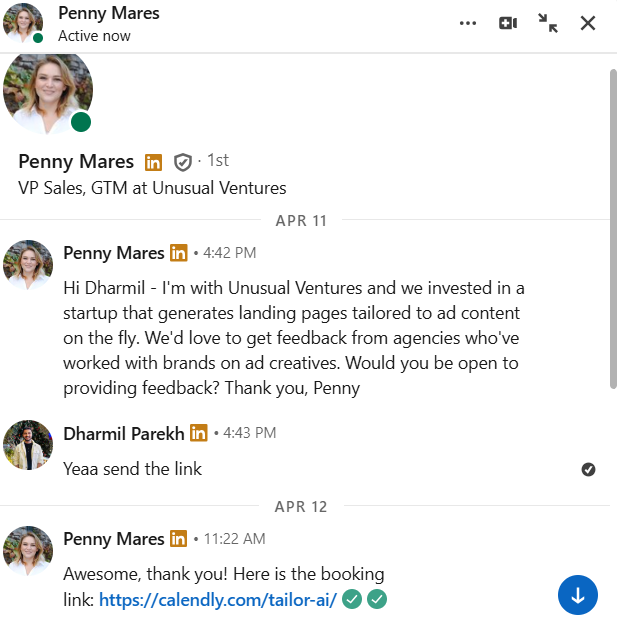
This simple message outperforms generic requests by acknowledging context (the group comment), implying value (effective approaches), and establishing relevance (similar companies).
The timing of your requests also significantly impacts acceptance rates. Sending requests on weekdays typically yields higher acceptance rates than weekends, with morning requests (9-11am local time) performing best.
With your optimized profile and strategic connection approach in place, it's time to develop the content strategy that will attract inbound leads while nurturing your existing connections.
Step 3: Using Content to Attract B2B Leads on LinkedIn
Think of LinkedIn content like a magnet. When done right, it pulls in the right people—your ideal B2B prospects—and filters out those who aren’t a good fit. That’s the power of a strong content strategy for B2B LinkedIn lead generation.
Instead of always chasing leads, your content can bring them to you. By sharing helpful insights around your audience’s real problems, you build trust. You're not just saying you're an expert—you’re proving it through valuable content that speaks to their pain points.
This strategy works beautifully alongside your outbound efforts. While you’re reaching out to targeted prospects, your content is silently working in the background, attracting even more potential leads you may not have found yet.
But here’s the secret: consistency.
If you want to generate B2B leads on LinkedIn effectively, you need to show up regularly. Posting once a week (or more) helps you get noticed by the algorithm, which boosts your visibility and reach over time. That consistent presence builds momentum and creates a steady flow of inbound leads—so you're not relying only on outreach.
Just keep in mind, not all content types work the same for B2B lead generation.
Here are a few practical examples of how to use content to attract B2B leads:
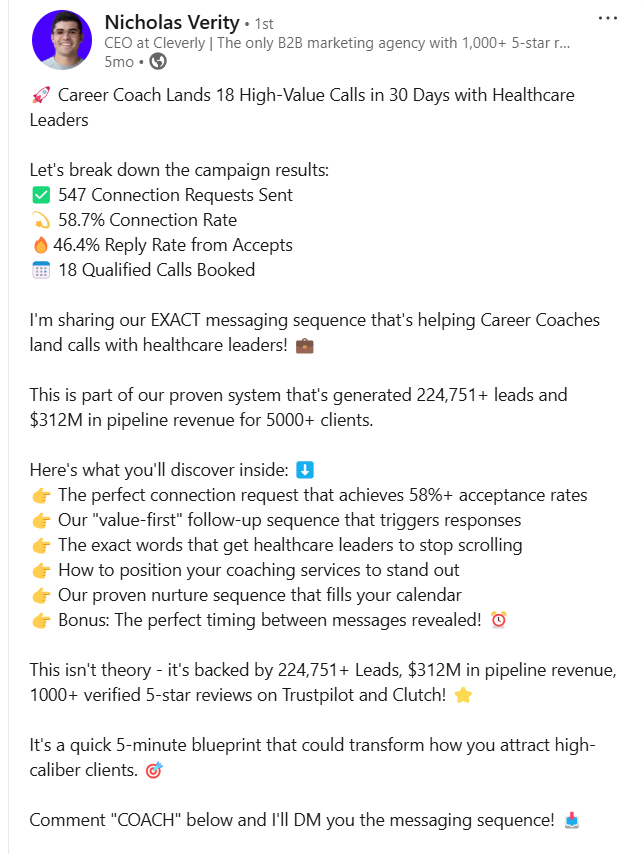
1. Industry Insights & Trends
Example: Share a post with your take on a new trend in your sector, such as “3 Ways AI Is Transforming Supply Chain Management in 2025.” Include data, your opinion, and a CTA (call to action) like “What changes are you seeing in your organization?”
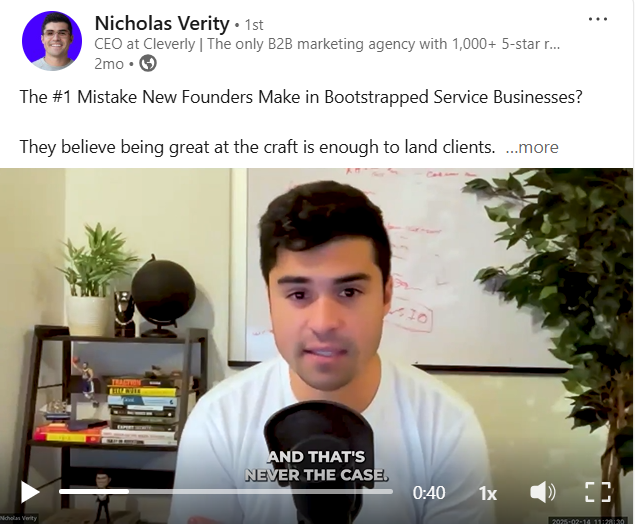
2. Thought Leadership Posts
Example: Publish a LinkedIn article or post outlining your unique perspective on a common challenge, such as “Why Most B2B Lead Generation Strategies Fail—and What to Do Instead.”
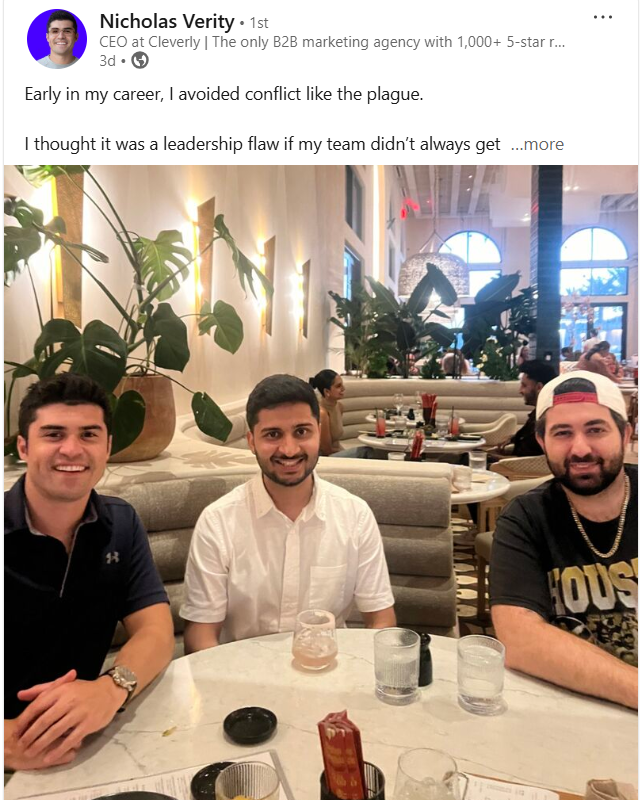
3. Behind-the-Scenes & Team Spotlights
Example: Share a behind-the-scenes look at your process or a day-in-the-life of a team member. For instance, “Here’s how our sales team builds trust with enterprise buyers in the first 5 minutes.”
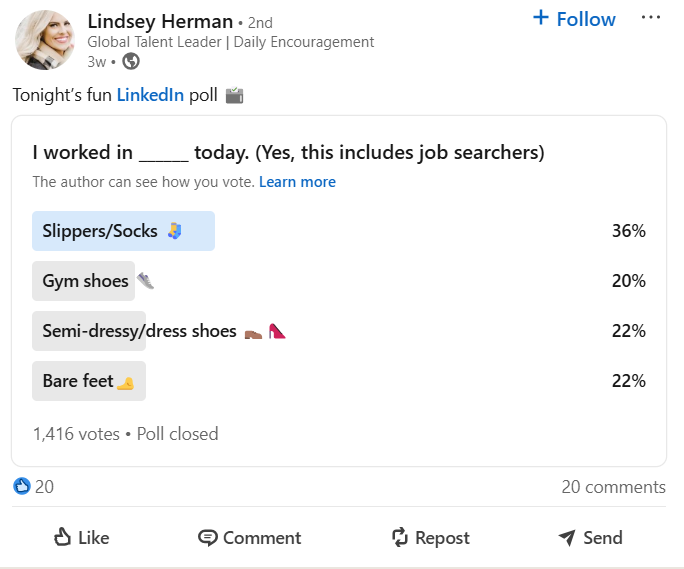
4. Interactive Content
Example: Create a poll like “What’s your biggest challenge in B2B marketing right now?” Use the results to spark a follow-up post with insights and solutions.
5. Free Resources & Tools
Example: Offer a downloadable whitepaper, checklist, or free tool with a post like “Download our free B2B Lead Generation Audit Template – the exact tool we use with our clients.”
The next step is figuring out what kinds of content actually perform best.
Hosting LinkedIn Events and Webinars as a Lead Source
Here's a content format that does something none of the five examples above can: it puts you in a live room with your prospects, and hands you their contact information as a byproduct of showing up.
LinkedIn Events lets you create a native event (a webinar, panel, or AMA), promote it to your network and relevant groups, and let people RSVP without leaving the platform.
The real value isn't the event itself. It's the attendee list.
Every person who registers becomes a warm prospect you now have a legitimate reason to contact. You're not cold messaging a stranger, you're following up with someone who already raised their hand.
A simple sequence around this looks like:
Before the event:
- Post about it 2 to 3 times in the run-up, each time from a different angle (the topic, a guest speaker, a specific outcome attendees will walk away with).
- Personally invite your top ICP prospects rather than relying on the algorithm alone.
After the event:
- Send a thank-you message to everyone who attended within 24 hours, ideally with a recording or a related resource.
- Wait a few days, then follow up with the specific point from the session that ties back to your service.
This converts better than cold outreach on its own because the context is already built in. You're not asking someone to trust you from a standing start, you're picking up a conversation you already started together, live.
⚡ For deeper event outreach tactics: LinkedIn Event Outreach: How to Find Attendees and Turn Conferences Into Pipeline
Launching a LinkedIn Newsletter to Build an Owned Audience
If content and events give you reach, a newsletter gives you something more durable: a subscriber list you own inside LinkedIn.
Once Creator Mode is turned on, you can launch a newsletter and publish on a regular cadence, weekly or biweekly works well for most B2B teams. Every time you publish, LinkedIn notifies subscribers directly, both in-app and by email.
That notification is the whole point. A single post competes for attention in a crowded feed. A newsletter issue lands in someone's inbox with your name on it.
Subscribers are a more durable asset than post engagement for one simple reason: a like disappears the moment someone scrolls past it, but a subscriber stays subscribed until they choose to leave. LinkedIn newsletters have grown subscribers at roughly 150% year over year, making them one of the fastest-growing formats on the platform, and open rates in the 30 to 50% range routinely beat standard email newsletters.
Treat your subscriber list the way you'd treat any other lead source. Export it periodically and sync new subscribers into your CRM so they enter a proper nurture track instead of sitting inside LinkedIn where you can't reach them if they ever go quiet on the platform.
This pairs directly with the content calendar covered above. Your regular posts build reach and trust. Your newsletter turns a slice of that audience into something you can nurture on your own terms.
⚡ For a full publishing framework: How to Create a Newsletter on LinkedIn
Content Types That Generate B2B Leads on LinkedIn
LinkedIn offers multiple content formats, each with distinct advantages for different lead generation objectives. The platform's current algorithm heavily favors:
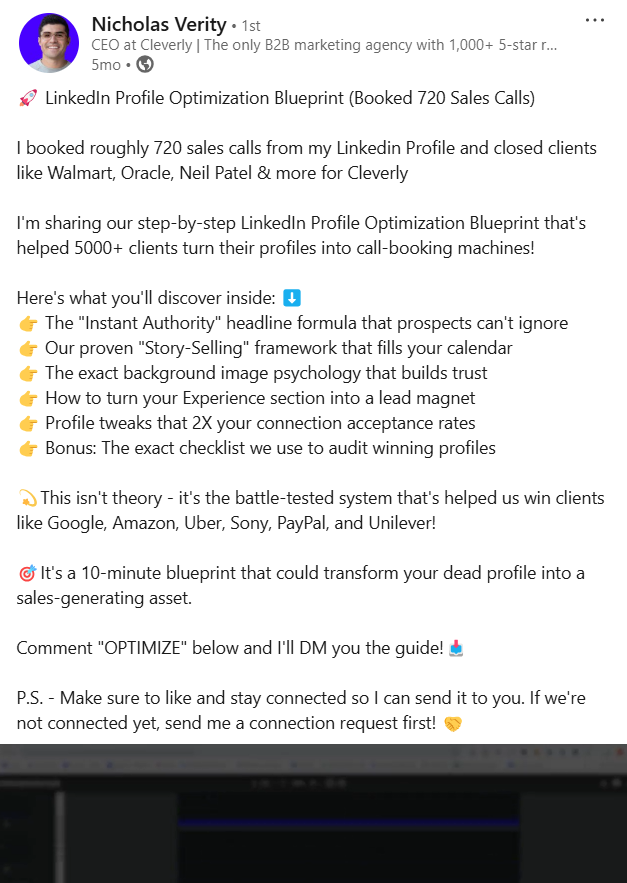
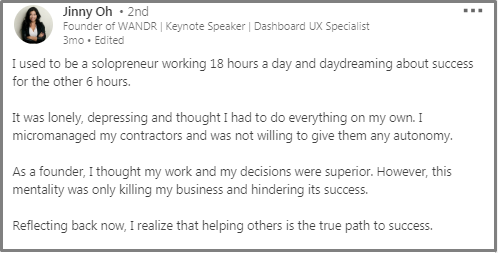
- Text-only posts with compelling questions or contrarian perspectives
Example:
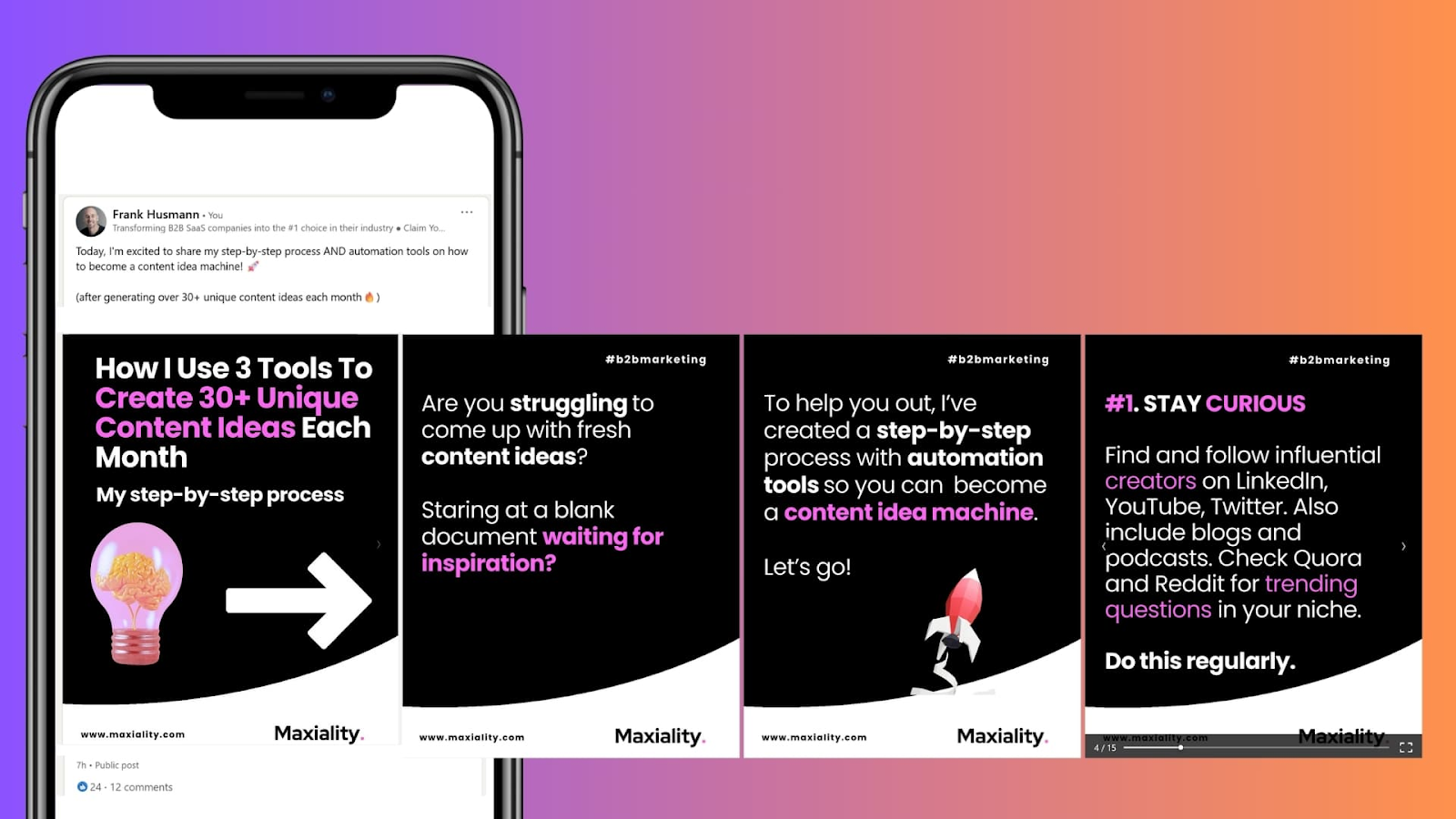
- Carousel posts that deliver multiple insights in a swipeable format
Example:
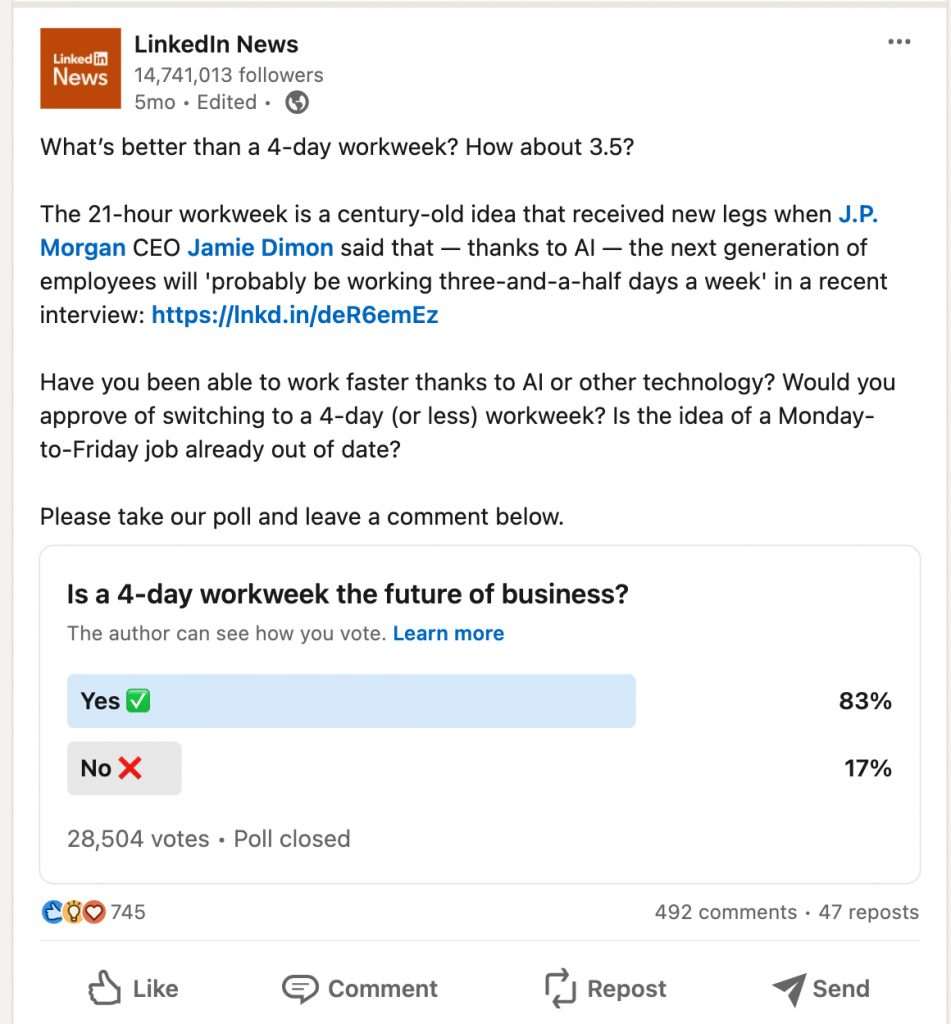
- Native polls that encourage widespread engagement
Example:
- Authentic, brief videos that feel personal rather than polished
Example:
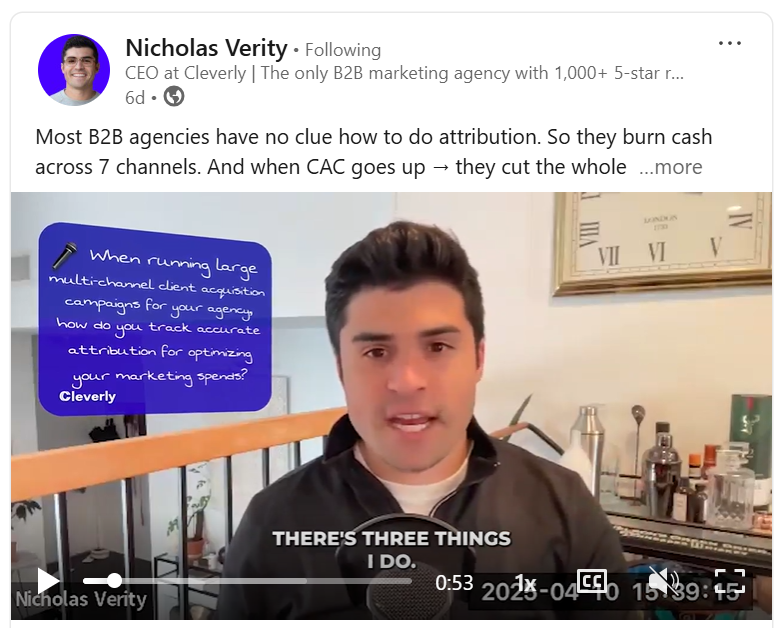
Traditional article publishing, while valuable for depth, typically generates less immediate engagement than these formats. The most effective approach combines formats based on where prospects are in their journey.
Text posts with controversial opinions are great for attracting new connections, while detailed carousels were better for nurturing existing relationships. When you matched content types to relationship stages, your conversion rate from connection to conversation can even be doubled.
Understanding the current state of LinkedIn's algorithm is crucial for maximizing reach. As of 2025, the platform continues to prioritize content that:
- Generates comments within the first hour of posting
- Keeps users on the platform (native content over external links)
- Creates back-and-forth conversation (not just reactions)
- Appeals to specialized professional interests rather than broad topics
The engagement triggers that consistently drive comments include asking specific questions, challenging conventional wisdom, sharing surprising data points, and revealing mistakes or lessons learned. These elements create what psychologists call "information gaps" that compel professionals to contribute their perspective.
For sustainable results, a simple content calendar that ensures consistent posting while varying content types is essential. The most manageable approach for busy professionals is to batch-create content monthly, with a minimum viable schedule of:
- 2 opinion/insight posts weekly
- 1 deeper educational piece biweekly
- 1-2 engagement posts weekly (commenting on others' content)
This level of consistency puts you ahead of most of LinkedIn users while requiring just 2-3 hours of content preparation monthly.
Storytelling: Your Secret Weapon for B2B LinkedIn Lead Generation
In the flood of professional posts on LinkedIn, storytelling is what makes you stand out. It’s not just about sharing tips—it’s about making people feel something. Stories connect on an emotional level, which makes your message stick and encourages action.
The most effective stories begin with a hook that interrupts the scroll. Most users are quickly skimming through their feed, so your first line needs to grab their attention. For example:
- ❌ Typical start: “Customer retention is important for SaaS growth.”
- ✅ Scroll-stopper: “We lost a $1.2M client last week. Here’s what it taught us about retention.”
The second one? It makes people pause—and that’s half the battle won.
If you're wondering how to write compelling LinkedIn stories for B2B lead generation, here’s a simple format to follow:
- Situation – Set the scene with a relatable business context.
- Complication – Introduce a problem or challenge.
- Turning Point – What changed? What did you realize?
- Resolution – Share the outcome or result.
- Lesson – Wrap it up with an insight others can apply.
This approach works because it mirrors real-world decision-making in B2B—it feels genuine, not like a sales pitch.
And don’t shy away from showing a little vulnerability. Posts that admit mistakes or tough lessons often get the most engagement.
Why?
Because they make you relatable and approachable, which builds trust.
To tie it all together for LinkedIn B2B lead generation, include a subtle call to action. Nothing salesy—just a natural next step, like:
- Offering a free resource or deeper guide
- Inviting people to DM you for a quick tip or perspective
- Asking a question to spark conversation
- Suggesting a small action based on your story
With storytelling bringing the right people to your content, the next step is turning that interest into real B2B leads through strategic outreach.
⚡ We break it down here: The 6 Sales Pipeline Stages Every Marketer Should Know
🚀 Scale LinkedIn Outreach
Starting at $397/month, Cleverly combines targeted prospecting and personalized outreach to help B2B teams generate more qualified conversations.
Step 4: Implement a Systematic Outreach Campaign
LinkedIn B2B lead generation isn’t about random DMs or sendin g connection requests when you remember. To get real results, you need a system—a repeatable outreach process that works like a well-oiled machine.
Many people approach LinkedIn opportunistically, messaging prospects whenever they have a free moment. But that usually leads to inconsistent results, missed follow-ups, and a lot of wasted effort.
A better way? Treat your LinkedIn lead generation like a process, not a guessing game.
Here’s the challenge most B2B businesses face:
- Manual outreach feels personal and gets good responses—but it’s time-consuming and hard to scale.
- Automated outreach saves time—but often feels cold, spammy, and hurts your brand.
The sweet spot lies in combining both. Create a system where key parts are automated—like finding the right people or tracking follow-ups—but your messages still feel human and tailored. That way, you can scale your efforts without sounding like a robot.
With a structured outreach process, you can generate B2B leads on LinkedIn consistently—without spending your whole day on the platform. It saves time, reduces stress, and keeps your pipeline full of high-quality opportunities.
⚡ Uncover key insights: How to Use LinkedIn Prospecting Tools to 10X Your Leads
Crafting Messaging Sequences That Converts B2B Lead
The psychology behind effective LinkedIn messaging is fundamentally different from email or other marketing channels. LinkedIn conversations exist in a professional but personal context, creating unique expectations for communication.
The most successful messaging sequences recognize this hybrid nature by embracing conversation patterns that feel natural between professionals rather than overtly marketing-oriented.
To achieve this natural feel, structure your outreach following this proven sequence:
- Value-First Connect: A personalized connection request that offers insight rather than asking for anything
Example: Hi [First Name], I’ve been diving into [industry/topic] trends lately and noticed you work in this space. Would love to connect and share insights—especially around [relevant challenge, e.g., B2B SaaS lead gen]. - Appreciation Touch: A brief thank-you for connecting that introduces a relevant resource
Example: Thanks for connecting, [First Name]! I recently came across a report on [specific trend or stat relevant to them]—thought you might find it useful too. Happy to send it over if you're interested. - Insight Message: A valuable perspective on a challenge common in their role/industry
Example: One thing I keep seeing with [role/industry] leaders is how tough it’s been to [address common pain point—e.g., convert cold leads into warm conversations]. We’ve found that small tweaks in messaging cadence can make a big difference. Curious—have you noticed the same in your outreach efforts? - Soft Engagement: A question about their experience with this challenge
Example: Out of curiosity, how are you currently approaching [insert challenge]? A lot of folks I’ve spoken to are testing different outreach styles but aren’t sure what’s actually working.
- Direct Value Offer: A clear but low-pressure opportunity to learn how you might help
Example: Not sure if it’s relevant right now, but we help [type of companies] optimize LinkedIn outreach—from targeting to messaging and follow-ups. If you’d ever like a second pair of eyes on your process or want to see how we approach it, happy to share. No pressure at all!
This patient approach significantly outperforms the typical connect-and-pitch strategy most users employ. By demonstrating value before requesting engagement, you establish trust that makes the eventual conversation feel earned rather than forced.
The challenge comes in maintaining personalization while scaling this approach. The solution lies in templatizing structure while personalizing content.
⚡ Check this out: Cold Sales Email Templates That Made Our Clients $37.6M
Create message frameworks where you can insert prospect-specific elements based on their profile, recent activity, or company news.
For example, a message might follow this framework:
"I noticed [specific observation about prospect]. This often suggests [relevant business challenge]. We've helped [similar companies] address this by [brief solution approach], resulting in [specific outcome]. I'd be happy to share some specific insights about how this might work for [prospect's company] if that would be valuable."
The framework remains consistent while the bracketed elements change based on the individual prospect, creating personalization at scale.
This approach to personalization at scale is where Cleverly clients gain significant efficiency—maintaining the quality of custom outreach while dramatically increasing quantity through smart automation.
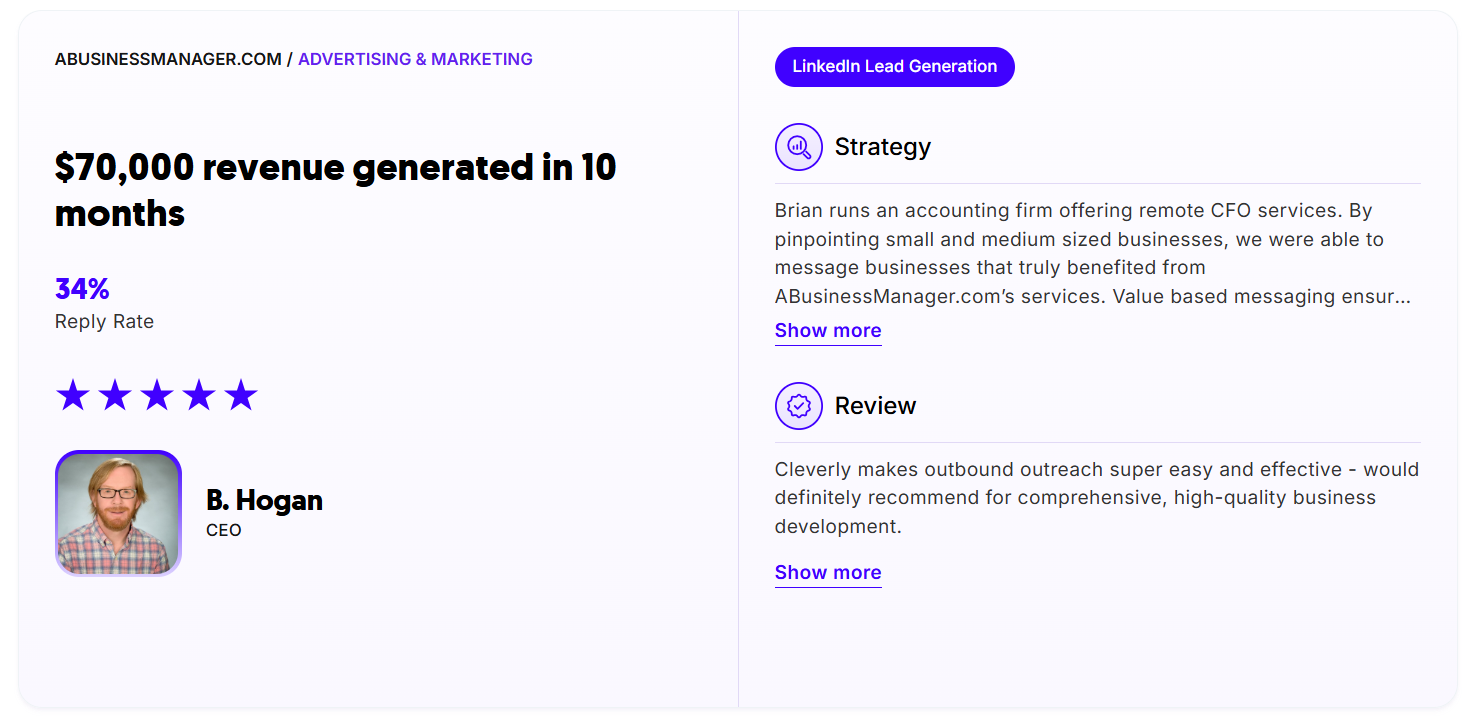
Read Case Study: $70,000 revenue generated in 10 months
Timing and Frequency Best Practices
When it comes to LinkedIn lead generation, when you reach out can be just as important as what you say. You might be sending great messages, but if they land at the wrong time, they could easily get ignored.
So, what’s the best time to connect with your ideal B2B prospects on LinkedIn?
Generally, weekdays work best—especially midweek. People are usually swamped on Mondays and mentally checked out by Friday. Reaching out between Tuesday and Thursday during working hours (preferably mid-morning or early afternoon in their local time) tends to get more attention.
But timing doesn’t stop with your first message. Follow-ups are where the magic really happens—if you do them right.
Instead of waiting too long between follow-ups (or ghosting prospects after one message), try building a simple, spaced-out follow-up sequence. Here’s a good starting point:
- Initial message
- Follow-up #1: 2-3 business days later
- Follow-up #2: 5-6 days after that
- Follow-up #3: About a week later
That gives your prospect breathing room without letting the conversation go cold. And remember—each follow-up should offer something useful, not just “checking in.” Share a tip, a resource, or a quick insight that ties back to their role or pain points.
One common question is: How many follow-ups is too many? A good rule of thumb is to keep it to three follow-ups after your first message. That’s enough to show genuine interest without being annoying.
Lastly, test and tweak your approach. Every industry and audience is different. Try different send times, message styles, or follow-up spacing—and see what gets the best engagement for your B2B LinkedIn lead generation strategy.
Step 5: Measure, Analyze, and Optimize Your LinkedIn Lead Generation
Consider your LinkedIn strategy a laboratory where you're constantly experimenting, much like Emma, the marketing director for a B2B software company.
"We initially judged our LinkedIn efforts by vanity metrics like followers and likes," she recalls. "When we shifted to measuring actual pipeline contribution, we discovered our clever, highly engaging posts were attracting the wrong audience entirely. Refocusing on fewer, more technical topics that performed 'worse' by engagement standards actually tripled our qualified leads."
This highlights a crucial truth: in B2B lead generation, the metrics that matter aren't always the ones that feel good. Connection counts and engagement rates are meaningless if they don't translate to qualified sales conversations and revenue.
Developing a continuous improvement mindset is essential for sustainable results. The LinkedIn algorithm, professional communication norms, and buyer expectations all evolve constantly. What worked six months ago may be significantly less effective today.
This reality makes adaptation crucial for long-term success. The companies seeing the most consistent results from LinkedIn treat their strategy as a living system rather than a static process, regularly testing new approaches while maintaining what's working.
Key Performance Indicators for LinkedIn Lead Generation
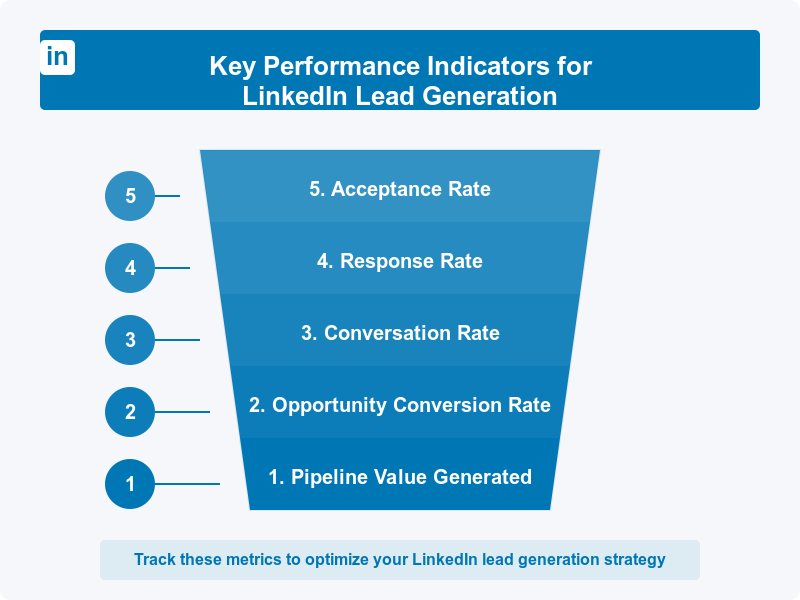
Not all LinkedIn metrics deserve equal attention. For B2B lead generation specifically, focus on this hierarchy of meaningful indicators:
- Pipeline Value Generated: The actual monetary value of opportunities sourced through LinkedIn
- Opportunity Conversion Rate: Percentage of LinkedIn-sourced conversations that become qualified opportunities
- Conversation Rate: Percentage of outreach sequences that result in meaningful two-way conversations
- Response Rate: Percentage of messages that receive any response
- Acceptance Rate: Percentage of connection requests accepted
Notice that follower count, post engagement, and profile views—metrics LinkedIn prominently displays—don't appear on this list.
While these indicators can provide useful diagnostic information, they're means to an end rather than meaningful business outcomes.
Tracking these metrics requires a simple but consistent system. The most effective approach combines LinkedIn's native analytics with a basic CRM or tracking spreadsheet that logs:
- Outreach volume (connections and messages sent)
- Response data (timing, sentiment, next steps)
- Conversation outcomes (meeting scheduled, qualified, disqualified)
- Opportunity progression (proposal, closed-won, closed-lost)
This tracking system doesn't need to be complex—even a simple spreadsheet updated weekly provides the visibility needed to identify trends and optimization opportunities.
At Cleverly, we've built our LinkedIn automation tool specifically to handle this tracking while scaling your outreach efforts. We've seen firsthand how our clients transform their results when they can send up to 500 targeted connection requests monthly and manage up to 800 open InMails—all while maintaining that crucial personalization.
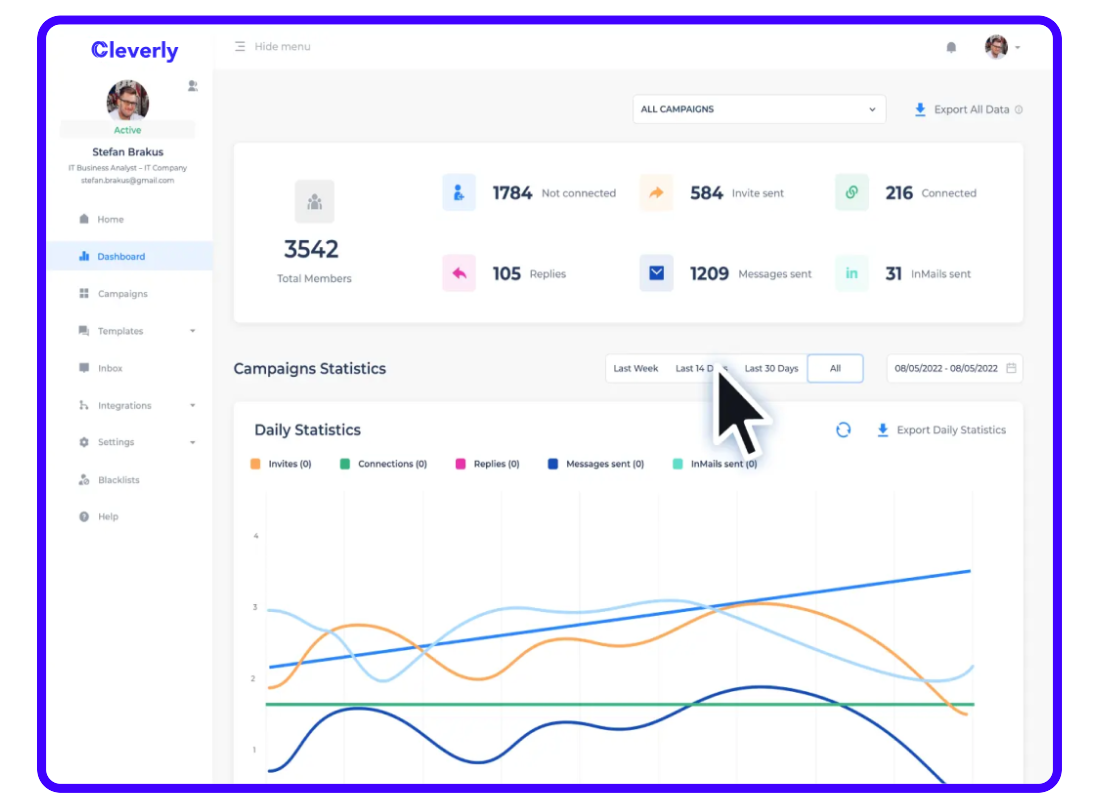
What makes the difference for our most successful clients is the ability to run multichannel campaigns that combine LinkedIn and email, import CSVs for hyper-personalized targeting, and leverage our real-time AI-driven lead management inbox.
Our advanced reporting goes beyond LinkedIn's native analytics to show you exactly which messaging sequences and timing patterns are generating the highest response rates.
For teams, our platform offers seamless collaboration with team management features, while our native integrations, API access, and two-way Zapier connections ensure your LinkedIn lead generation integrates perfectly with your existing CRM and marketing stack.
This consolidated approach eliminates the spreadsheet juggling most companies struggle with while providing much deeper insights into what's actually working.
We've helped 10,000+ clients generate leads with companies like:
- Amazon
- Google
- UBER
- PayPal
- Slack
- Spotify & more
That resulted in $312 Million in Pipeline Revenue, $51.2 Million in Closed Revenue through Linkedin Outreach.
If you're interested in generating qualified B2B leads through Linkedin then click here for more information.
Coming back, industry benchmarks also offer useful context for evaluating your performance.
While results vary significantly by sector, target audience, and approach, these general benchmarks provide a starting point:
- Connection request acceptance: 15-30% is good, >30% is excellent
- Message response rate: 10-25% is good, >25% is excellent
- Conversation to opportunity conversion: 5-15% is good, >15% is excellent
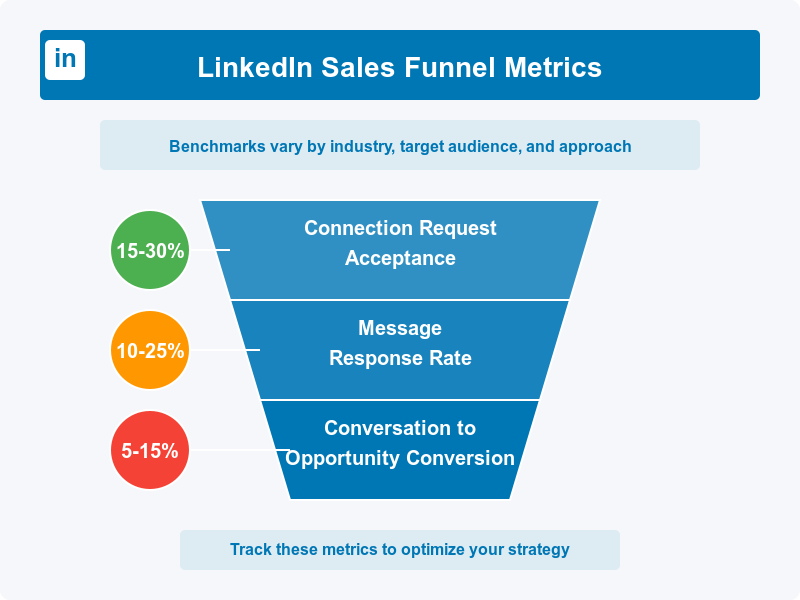
A simple visualization dashboard that tracks these metrics over time quickly reveals whether your approach is improving, plateauing, or declining—triggering appropriate adjustments to your strategy.
Common Pitfalls and How to Avoid Them
Even well-designed LinkedIn strategies can fall victim to common pitfalls that drain resources without generating results. The most prevalent include:
Time-wasting activities that create illusions of productivity. Endless profile browsing, unfocused content consumption, and reactive engagement might feel like "working on LinkedIn," but they rarely drive concrete outcomes. Combat this by scheduling focused LinkedIn blocks with specific, measurable objectives.
Relationship damage risks emerge when automation replaces judgment. Over-aggressive messaging, tone-deaf follow-ups, and obviously templated outreach don't just fail—they create active negative impressions that can spread through professional networks. Prevent this by reviewing all automation from the recipient's perspective and incorporating appropriate safety valves.
Sustainability challenges occur when approaches that produce short-term results prove impossible to maintain long-term. Highly manual personalization, content strategies requiring daily creation, and approaches relying on novelty often fall into this category. Design your system with realistic time commitments that align with your available resources.
For companies struggling with these challenges, Cleverly's approach prevents common mistakes by implementing tested systems that balance automation with personalization—maximizing efficiency while protecting professional reputation.
With your measurement system in place and pitfalls identified, it's time to create a concrete implementation plan.
LinkedIn Ads and Lead Gen Forms: Adding a Paid Layer to Organic Outreach
Everything covered so far is organic. No ad spend, just profile work, content, and outreach.
But if you have budget to work with, LinkedIn's paid tools can run alongside that system instead of replacing it.
Three ad formats matter most for B2B lead generation:
- Sponsored Content: Native posts that show up directly in the feed of your targeted audience, even if they don't follow your page yet.
- Message Ads: Ads delivered straight to a prospect's LinkedIn inbox, useful for a single, direct offer.
- Lead Gen Forms: A form that opens inside LinkedIn itself, attached to any ad format, and pre-filled with the viewer's profile data.
Lead Gen Forms deserve special attention because of how they perform. Sending someone from an ad to an external landing page adds friction: a new page to load, fields to type by hand, often on a phone. A Lead Gen Form skips all of that. The person taps the ad, sees their name, email, job title, and company already filled in, and submits with one more tap.
That difference shows up in the numbers. Lead Gen Forms convert at roughly 13% on average, close to three times the typical external landing page rate of around 4%, largely because there's nothing left to type.
Combine that with LinkedIn's targeting and paid starts to look less like a shot in the dark. You can layer job title, seniority, industry, and company size on top of the same prospect criteria from Step 2, then run Sponsored Content or Lead Gen Form campaigns against that exact audience while your outreach sequences work the same list from a different angle.
Where paid fits depends on your resources:
- Teams with budget: Use Lead Gen Forms for a low-friction offer (a guide, a template, a webinar seat) aimed at the same ICP your outreach targets, then let your SDRs or AEs follow up on anyone who converts.
- Organic-only teams: Skip paid for now and lean harder into the connection and content strategy in Steps 1 through 3. Paid amplifies a working system, it doesn't replace one.
If setting up and managing Lead Gen Form campaigns on top of everything else sounds like more bandwidth than your team has, this is exactly the kind of paid and organic combination Cleverly's LinkedIn lead generation service manages end to end.
⚡ For a full breakdown of ad types, targeting, and setup: LinkedIn Ads 2026 Master Playbook
Once paid traffic is coming in, the next question is what happens to the people who don't convert on the first ad they see. That's where retargeting comes in.
Retargeting Warm Visitors With the LinkedIn Insight Tag
Most people who see your ad, read your blog post, or land on your pricing page are not ready to buy yet. That's normal. The mistake is treating that first visit as a dead end instead of the start of a longer conversation.
The LinkedIn Insight Tag fixes that. It's a small piece of JavaScript you add to your website that lets LinkedIn track who's visiting, which pages they viewed, and how they found you. Once it's installed, you can build ad audiences straight out of your own site traffic.
Setup is simple:
- Generate the tag inside Campaign Manager.
- Add it to every page on your site, not just landing pages, so you capture full visitor behavior.
- Give it a few days to collect a usable audience size.
From there, build segmented audiences around specific behavior, for example:
- Ebook Downloaders: People who filled out a form for a specific resource.
- Pricing Page Visitors: People who looked at cost but didn't book a call.
- Blog Readers: People who spent real time on a specific article, like this one.
Once those segments exist, re-serve relevant ads to people who've already shown interest instead of paying to reach cold strangers again. Someone who read your pricing page sees a case study or a limited-time consultation offer. Someone who downloaded a guide sees an invitation to a related webinar.
This matters because most of your traffic, paid or organic, isn't ready to convert on the first touch. Retargeting members who've already been exposed to your brand converts roughly 6 times better than targeting a cold audience from scratch. The Insight Tag is what makes that math work. Without it, every visitor who leaves your site without converting is just gone.
⚡ Want the full setup walkthrough? The Complete Guide to LinkedIn Campaign Manager
With paid reach and retargeting covering the top of the funnel, it's time to circle back to measuring what actually matters.
Bringing It All Together: Your LinkedIn Lead Generation Action Plan
Transforming your LinkedIn presence from passive networking to active lead generation requires a structured implementation approach. Based on our experience helping hundreds of B2B companies implement this playbook, we recommend this timeline:
Weeks 1-2: Foundation Building
- Optimize personal profiles and company page
- Define ideal prospect criteria and search strategies
- Create initial message sequence templates
- Establish baseline metrics tracking system
Weeks 3-4: Initial Implementation
- Begin targeted connection campaigns (25-50 connection requests daily)
- Implement basic content calendar (2-3 posts weekly)
- Start initial outreach sequences to existing connections
- Document early results and optimize messaging
Weeks 5-8: Scaling Phase
- Increase connection volume to optimal level (50-100 daily)
- Expand content strategy to include multiple formats
- Implement A/B testing on message sequences
- Refine targeting based on initial response data
Weeks 9-12: Optimization Phase
- Analyze conversion data to identify highest-value prospect segments
- Optimize messaging based on response patterns
- Scale successful content approaches
- Implement referral strategies within growing network
For resource allocation, a sustainable LinkedIn lead generation system typically requires:
- 2-3 hours weekly for content creation and scheduling
- 1-2 hours daily for outreach and response management
- 1-2 hours weekly for analytics review and strategy adjustment
This investment typically produces meaningful results within 30-45 days, with the system reaching optimal performance around the 90-day mark as your network, content equity, and messaging approach mature.
The realistic timeline for seeing specific results varies by industry and target audience, but generally follows this pattern:
- Network growth and initial engagement: Immediate (days)
- Consistent response rates: Short-term (2-4 weeks)
- Qualified conversations: Medium-term (4-8 weeks)
- Closed business: Longer-term (8-12 weeks+)
When to Consider Outsourcing Your LinkedIn Lead Generation
Let’s be honest—LinkedIn lead generation sounds great in theory, but actually doing it consistently is a whole different game.
For most B2B companies, deciding whether to build an in-house system or outsource it usually comes down to three things: expertise, time, and opportunity cost.
To do it right, you need more than just LinkedIn know-how. You need strong messaging, copy that actually converts, solid targeting strategy, and the ability to analyze results and tweak things as you go. Sure, you can build that in-house—but the learning curve is real.
Then there’s the time factor. Even with systems in place, LinkedIn outreach takes time—like, 15+ hours a week kind of time. And for most busy founders, sales teams, or marketers, that’s time better spent closing deals, delivering client work, or focusing on growth.
That’s where outsourcing becomes a no-brainer. Instead of spending months figuring it all out yourself, you can have a proven system up and running in weeks.
And if you're thinking of outsourcing, that’s exactly where our team at Cleverly comes in.
We handle everything—from finding the right prospects and writing high-converting messages to running the outreach for you and notifying you instantly when a lead responds. So all you have to do? Step in and close the deal.
No more guesswork. No more wasted hours. Just a steady flow of warm leads, delivered straight to your inbox.
⚡ Take a closer look: Outsourced Lead Generation - Why 1,500+ Clients Trust Us
Conclusion: Taking the Next Step in Your LinkedIn Lead Generation Journey
LinkedIn stands alone as the most powerful platform for B2B lead generation, offering unprecedented access to decision-makers in a professional context designed for meaningful business conversations. But this potential remains untapped for companies lacking a systematic approach.
The five-step playbook we've outlined transforms LinkedIn from a passive professional network into a proactive lead generation engine:
- Optimize your presence to attract and engage your ideal prospects
- Build a strategic network focused on quality over quantity
- Develop content that positions you as a trusted authority
- Implement systematic outreach that balances personalization and scale
- Measure, analyze, and continuously optimize your approach
This system creates a sustainable pipeline of qualified opportunities without requiring you to become a full-time LinkedIn expert.
If you take just one action today, focus on optimizing your profile to speak directly to your prospects' challenges rather than listing your own achievements. This fundamental shift immediately improves results from all your LinkedIn activities.
For those ready to implement this complete playbook but lacking the time or specialized expertise, Cleverly offers a turnkey solution. Our team implements this exact system for hundreds of B2B companies, handling everything from profile optimization to daily outreach while you focus on converting the qualified meetings we generate.
As B. Hogan, the CEO of Abusinessmanager.com, shares: "Cleverly makes outbound outreach super easy and effective - would definitely recommend for comprehensive, high-quality business development."
So, whether you choose to implement this playbook yourself or with expert support like Cleverly, the opportunity is clear: LinkedIn offers unprecedented access to your ideal B2B prospects.
Ready to finally make LinkedIn work for your B2B business? Let’s talk!
Book a FREE strategy session to discuss how we can implement this playbook for your specific B2B company.
Frequently Asked Questions
Free Resource
How to Scale a Profitable Cold Call System
Get the complete guide — download it instantly now.
Free Ebook
Download the Free Guide
Enter your details to get instant access.
You're all set! 🎉
Your ebook is downloading now.
Click below if the download didn't start automatically.