

Table of Contents
What Is a Lead Generation Chatbot?
How We Evaluated the Best Lead Generation Chatbots
Best Lead Generation Chatbots (2026 List)
Lead Generation Chatbots vs Forms — Which Works Better?
How Cleverly Uses Conversational Touchpoints to Generate Qualified B2B Leads
Conclusion
Frequently Asked Questions
Modified On :
October 26, 2026
Key Takeaways
- Lead generation chatbots capture and qualify prospects 24/7, turning website visitors into booked meetings automatically.
- The best chatbot for lead generation depends on your business size, sales complexity, and whether you need AI or rule-based flows.
- Chatbots convert 2-3x better than static forms on high-intent pages like pricing and demo requests.
- AI-powered chatbots handle complex B2B conversations while rule-based bots work great for straightforward lead capture.
- Chatbots work best when integrated with your CRM and paired with systematic follow-up across multiple channels.
- Tools like Drift and Intercom suit enterprise teams, while Tidio and ManyChat fit small businesses and e-commerce brands. Respond.io fits businesses generating leads through WhatsApp, social messaging, and other channels.
We've all been there. A prospect lands on your website at 2 AM, browses your pricing page, and leaves without a trace. No email, no demo request, nothing.
That's where a lead generation chatbot changes the game.
Instead of waiting for visitors to fill out forms (which most won't), chatbots for lead generation start conversations instantly. They qualify prospects while you sleep, book meetings on autopilot, and capture contact details before people bounce.
But here's the catch: not all lead generation chatbots are built the same. Some excel at simple lead capture. Others use AI to handle complex B2B conversations. And a few can actually integrate with your CRM and sales workflow without making your team want to quit.
We've tested dozens of platforms to find the best chatbots for lead generation in 2026. Whether you're a SaaS startup, ecommerce brand, or B2B lead generation agency looking to scale, this list covers what actually works, what it costs, and who each tool is built for.
Let's get into it.

What Is a Lead Generation Chatbot?
A chatbot for lead generation is a software tool that talks to your website visitors in real time to capture and qualify leads automatically.
Instead of making people fill out boring contact forms, these chatbots start conversations. They ask questions, collect information, and move prospects closer to a sale without needing your sales team online 24/7.
Here's what a typical lead generation chatbot does:
- Captures leads by collecting names, emails, and company details through conversation.
- Asks qualification questions like budget, timeline, and pain points to filter out tire kickers.
- Routes qualified leads to the right sales rep based on criteria you set.
- Books meetings directly into your calendar without the back-and-forth email dance.
Rule-Based vs AI Chatbots: What's the Difference?

Not all chatbots for lead generation work the same way.
Rule-based chatbots follow pre-written scripts. You click Option A, they show Response B. Simple, predictable, and easy to set up. Great for straightforward lead capture.
AI lead generation chatbots use natural language processing to understand what people actually mean. They handle complex questions, adapt conversations on the fly, and feel more human. Better for technical products or B2B sales where questions get detailed.
The best chatbot for lead generation depends on your use case. Simple product? Rule-based works fine. Complex B2B sale? You'll want AI.
Know More About: High-Converting Lead Generation Funnel
💬 Chatbots Capture. We Close.
Cleverly turns inbound interest into pipeline using LinkedIn outreach, pay-per-meeting cold email, and guaranteed cold calling, so no lead goes cold.
How We Evaluated the Best Lead Generation Chatbots
We didn't just Google "best chatbot for lead generation" and call it a day. We actually tested these tools based on what matters when you're trying to turn website traffic into pipeline.
What we looked at:
✅ Ease of setup and use – Can your team actually build and launch this without a developer?
✅ Lead capture and qualification depth – Does it just grab emails, or does it ask smart questions that filter out junk leads?
✅ AI and automation capabilities – How well does it handle real conversations vs following rigid scripts?
✅ CRM and calendar integrations – Does it sync with your existing sales stack or create more data entry work?
✅ Customization and branding – Can you make it match your website, or does it scream "generic chatbot"?
✅ Reporting and analytics – Can you see what's working, or are you flying blind?
✅ B2B vs B2C suitability – Is it built for quick consumer sales or longer enterprise deals?
✅ Pricing transparency – Do they show real pricing, or make you book a demo to find out it costs $10K/month?
Now let's look at the tools that actually passed the test.
More Tools: Best GTM Tools to Accelerate Your Growth
Best Lead Generation Chatbots (2026 List)
Each chatbot below supports lead generation, but they differ in intelligence, customization, and ideal use case.
1. Drift

Drift is a conversational AI platform built for B2B companies that want to replace lead forms with real-time chatbot conversations. It uses AI-powered playbooks to engage visitors 24/7, qualify prospects instantly, and book meetings without your sales team lifting a finger.
Key Features:
- Conversational AI that handles natural, personalized conversations without pre-written scripts.
- Real-time lead qualification filters high-intent prospects and routes them to sales immediately.
- Autonomous meeting scheduling books calls directly into your team's calendar.
- Proactive chat playbooks trigger targeted messages based on visitor behavior or account data.
- Deep CRM integration syncs instantly with Salesforce, HubSpot, and Marketo.
- Visitor identification recognizes known accounts and personalizes messages for high-value prospects.
- Fastlane form replacement lets VIP visitors skip forms and go straight to scheduling.
Best for: Enterprise and mid-market B2B companies running account-based marketing campaigns.
Pricing: Premium tier starts around $2,500/month (annual billing). Enterprise plans require custom quotes.
2. Intercom

Intercom is an AI-powered conversational platform that combines live chat, proactive messaging, and the Fin AI bot to turn website visitors into qualified leads around the clock. It triggers conversations based on visitor behavior and automates qualification before handing off hot prospects to your sales team.
Key Features:
- Proactive behavioral engagement triggers personalized messages when visitors hit pricing pages or spend time on key features.
- AI-powered lead qualification uses Fin AI to ask budget, industry, and company size questions automatically.
- Seamless human handoff connects qualified leads to live sales reps the moment buying signals appear.
- Instant meeting scheduling lets prospects book demos directly in the chat without leaving your site.
- Contextual CRM integration syncs visitor data automatically with Salesforce and HubSpot.
- 24/7 automated lead capture collects contact details even when your team is offline.
Best for: SaaS and high-growth B2B companies that want to run sales and support from one platform.
Pricing: Essential starts at $29-$39/seat/month (annual). Advanced runs $85-$99/seat/month (annual). Fin AI charges $0.99 per successful resolution.
3. HubSpot Chatbot Builder

HubSpot's chatbot builder is a no-code conversational AI tool baked directly into the HubSpot CRM. It acts as a digital sales assistant that engages visitors with personalized conversations based on real-time CRM data, automatically capturing leads and booking meetings without forms.
Key Features:
- No-code builder lets you create conversation flows with a simple drag-and-drop editor.
- Native CRM integration syncs all chat data, contact history, and lead info instantly to HubSpot.
- Intelligent lead qualification uses branching questions to score and categorize prospects automatically.
- 24/7 availability captures leads outside business hours so you never miss opportunities.
- Meeting scheduling books demos directly in the chat interface.
- Proactive engagement triggers conversations based on page visits or time spent on site.
Best for: Small to enterprise teams already using (or planning to adopt) the HubSpot CRM ecosystem.
Pricing: Free plan includes basic chatbot functionality. Starter starts around $20/month (removes branding). Professional/Enterprise ranges from $500-$3,600+/month for advanced AI and automation.
4. Tidio

Tidio is an all-in-one customer service and lead generation chatbot platform that combines AI-powered bots (Lyro) with rule-based automation to capture and qualify website visitors. Its no-code builder lets you create custom chatbot flows in minutes, and it handles up to 70% of inquiries automatically.
Key Features:
- AI-powered lead generation (Lyro) answers FAQs and captures visitor info in real time.
- Customizable chatbot flows with pre-made templates for lead magnets and appointment booking.
- No-code visual builder creates complex conversation flows with drag-and-drop simplicity.
- Proactive visitor engagement triggers messages based on exit intent or specific page visits.
- Multichannel integration unifies Messenger, Instagram, and website chats in one inbox.
- CRM integrations sync captured leads automatically with HubSpot, Salesforce, and Pipedrive.
Best for: Small-to-medium e-commerce, real estate, and B2B service companies looking for affordable, no-code lead capture.
Pricing: Free plan includes 100 chatbot visits. Starter starts at $24/month (annual). Growth starts at $49/month (annual) with higher limits.
5. Respond.io
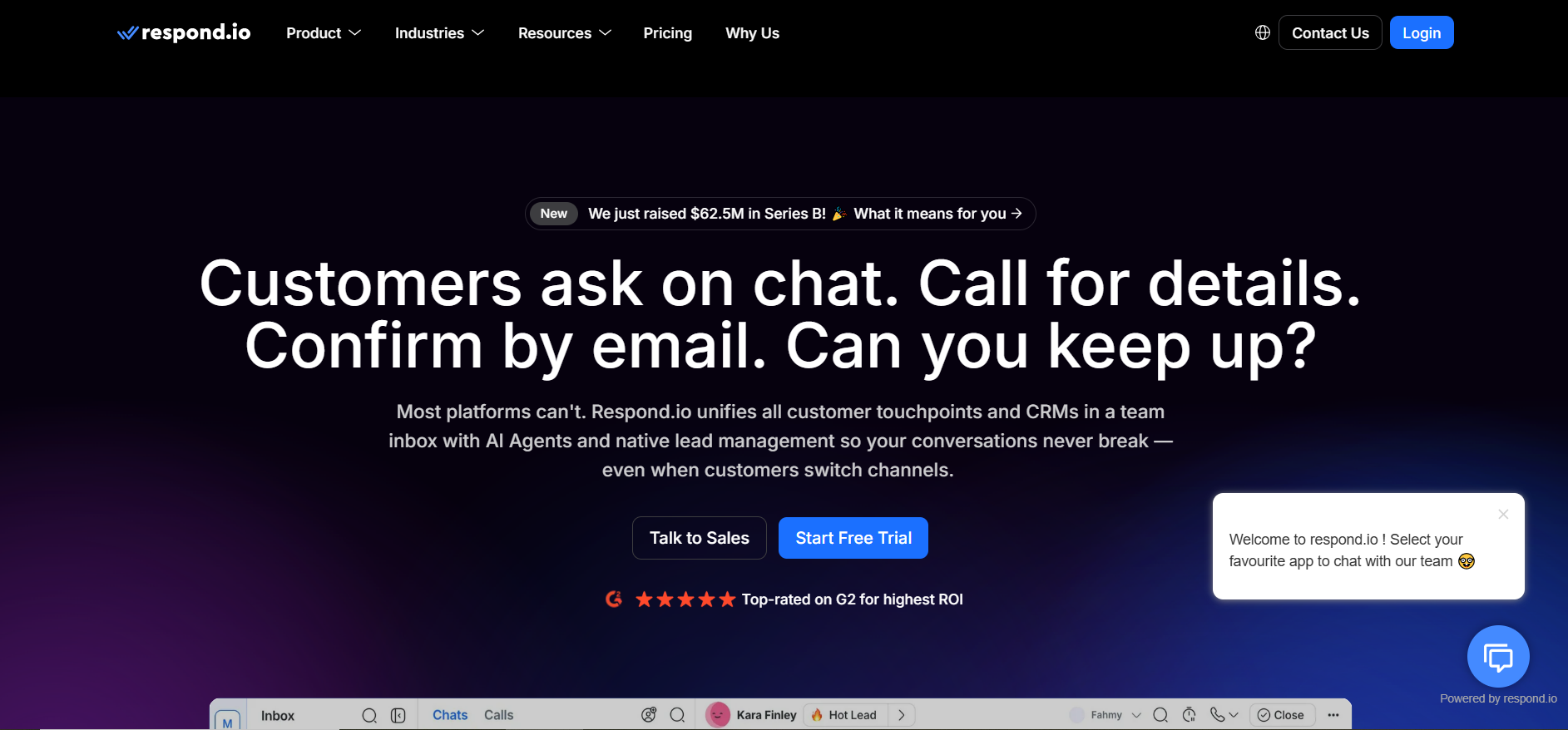
Respond.io is a customer conversation platform for high-volume, mid-market B2C businesses where customer conversations are directly tied to sales, bookings, or revenue. It brings WhatsApp, Instagram, Messenger, TikTok, Telegram, SMS, email, voice, and other channels into one workspace, with AI Agents and automation supporting lead qualification, follow-ups, routing, and human handoffs.
Key Features:
- Omnichannel inbox for customer conversations across multiple channels
- AI Agents for lead qualification, lifecycle updates, follow-ups, routing, and escalations
- Workflow automation for assignments, follow-ups, notifications, and conversation routing
- CRM integrations with platforms such as HubSpot and Salesforce
- Human handoffs for conversations that require human attention
- Customer lifecycle tracking from first contact through conversion and retention
Best for: High-volume B2C businesses that generate leads through messaging and need automated lead qualification, follow-ups, routing, and CRM-connected workflows.
Pricing: Respond.io starts at $99/month and uses Monthly Active Contacts pricing. It offers a 7-day free trial, while some advanced features are available on higher-tier plans.
6. Botpress

Botpress is a low-code AI agent platform that lets you build intelligent, LLM-powered chatbots for automated lead generation. It combines natural language understanding with generative AI to have human-like conversations that qualify prospects, capture details, and book meetings 24/7.
Key Features:
- AI-powered lead qualification asks tailored questions, analyzes intent, and identifies high-value prospects dynamically.
- CRM and integration hub connects directly with HubSpot, Salesforce, and Zendesk to sync data instantly.
- 24/7 automated engagement captures leads around the clock so nothing slips through outside business hours.
- Low-code visual builder lets you create custom conversation flows without heavy technical skills.
- Knowledge base integration ingests your website data and documents to answer product questions accurately.
- Automated scheduling books demos or appointments directly through the chat.
- Human handoff routes complex conversations or hot leads to live agents seamlessly.
Best for: Agencies, SaaS, and B2B businesses needing customizable AI agents to qualify high-volume traffic.
Pricing: Pay-as-you-go starts free with AI spend (500 messages, 1 bot). Plus runs ~$89/month + AI (5,000 messages). Team runs ~$495/month + AI (50,000 messages). Enterprise pricing is custom.
7. LivePerson

LivePerson is an enterprise-grade conversational AI platform that automates lead engagement 24/7 across web, WhatsApp, and social channels. It uses generative AI and advanced NLP to greet visitors, answer questions, and capture contact info through personalized conversations that convert significantly better than static forms.
Key Features:
- Proactive engagement triggers personalized messages based on browsing behavior to reduce bounce rates.
- AI-powered qualification uses NLP to analyze responses and qualify leads based on budget, timeline, and needs.
- Generative AI conversational flows create dynamic, context-aware dialogues instead of rigid scripts.
- Omnichannel reach deploys unified lead capture across websites, WhatsApp, Facebook Messenger, and SMS.
- CRM integration hub connects with Salesforce and HubSpot to sync lead data and update profiles instantly.
- Seamless human handoff escalates promising leads to sales teams with full conversation context.
Best for: Enterprise-level brands needing high-volume, secure, and customizable AI-driven customer acquisition.
Pricing: Custom enterprise pricing only (no published rates). Industry data suggests annual contracts often exceed $60,000, with premium tiers required for full generative AI features.
8. Landbot

Landbot is a no-code conversational builder that transforms static lead forms into engaging, interactive chat experiences. It lets marketing and sales teams create bot workflows for websites, WhatsApp, and Facebook Messenger without needing developers, using a hybrid approach of rule-based flows and AI agents.
Key Features:
- No-code visual builder designs complex lead conversations with a simple drag-and-drop interface.
- Conversational landing pages replace traditional web forms with full-screen, high-converting chatbot experiences.
- AI agents (Lyro) handle open-ended questions and improve engagement within brand guardrails.
- Multichannel deployment runs the same bot across web, WhatsApp, and Facebook Messenger.
- Native CRM integrations sync lead data instantly with HubSpot, Salesforce, Google Sheets, and Slack.
- Live chat handoff transfers conversations to human agents when high-intent leads are detected.
- Reusable "Bricks" use pre-built components to quickly build and update lead flows.
Best for: Marketing teams and agencies looking to improve conversion rates without developer dependency.
Pricing: Free plan includes 100 chats/month. Starter runs ~$40-46/month (500 chats). Pro runs ~$100-120/month (2,500 chats, custom branding). WhatsApp/Business starts at ~$200-233/month.
9. Freshchat

Freshchat is an AI-powered conversational engagement platform from Freshworks that transforms website and app interactions into lead generation opportunities. It deploys intelligent Freddy AI chatbots to engage visitors 24/7 across WhatsApp, Facebook Messenger, and web chat, with a no-code builder for easy customization.
Key Features:
- Proactive messaging engages visitors automatically based on behavior like pricing page visits or cart abandonment.
- No-code bot builder creates custom lead qualification workflows with simple drag-and-drop.
- AI-powered qualification uses Freddy AI to understand intent and ask relevant questions around the clock.
- Omnichannel reach captures leads across websites, WhatsApp, Instagram, and Facebook from one inbox.
- Instant lead capture collects contact information and syncs automatically with CRM tools.
- Seamless human handoff transfers qualified leads to live sales agents with full conversation context.
Best for: SMBs and mid-market companies in e-commerce, technology, and service industries needing automated lead qualification.
Pricing: Free plan available (up to 10 agents). Paid plans start around $19-29 per agent/month (annual billing), with additional costs for AI chatbot sessions.
10. SendPulse
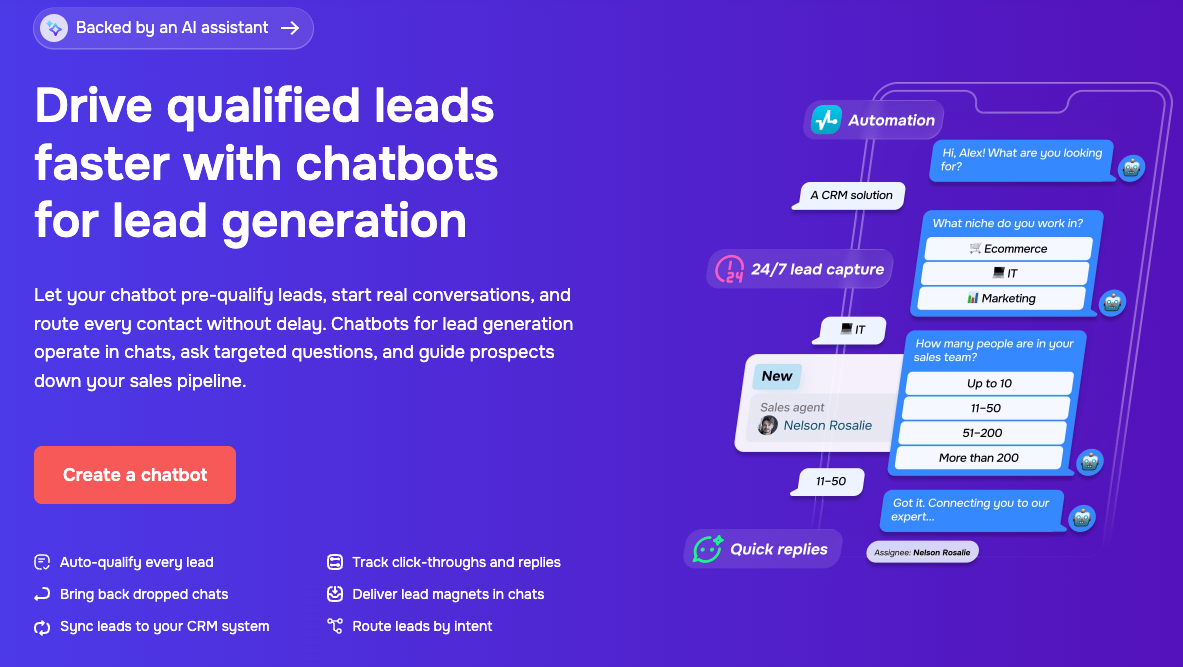
SendPulse is an AI-driven email marketing and chatbot platform that captures and qualifies leads directly inside Instagram, WhatsApp, Facebook, TikTok, Telegram, and Viber. As a Meta Partner and official WhatsApp Business API provider, it lets you build lead generation flows that start conversations the moment a prospect reaches out and pass qualified contacts straight into your sales pipeline.
Key Features:
- In-app lead capture replies to comments and story mentions, triggers on keywords, and pulls visitors in through subscription widgets, so prospects never have to leave the messaging app.
- Conversational qualification replaces static forms with short, focused questions that collect contact details and buying context.
- Intent-based routing assigns each lead to the right team member by topic, urgency, product, or location.
- Lead magnets in chat deliver checklists, coupons, or guides in exchange for contact info.
- Automatic follow-ups re-engage prospects who drop off mid-conversation.
- Real-time CRM sync sends every new contact, along with tags and variables, to your CRM the moment a lead qualifies.
- AI agents run lead generation flows around the clock and adapt replies to what users say, across languages.
Best for: Scaling businesses, e-commerce brands, and service companies that generate leads through social and messaging apps and want chat capture, qualification, and CRM in one platform.
Pricing: Free-forever plan includes 3 chatbots, up to 500 subscribers, and 10,000 messages per month. Pro starts at 12/month(9.60/month billed annually) for 500 subscribers, with unlimited chatbots, messages, and flows. WhatsApp conversations are billed separately at Meta's rates.
11. ManyChat

ManyChat is a no-code chat marketing platform that automates two-way conversations across Instagram, Facebook Messenger, WhatsApp, and SMS. It captures leads instantly, nurtures them through automated sequences, and drives sales directly within chat apps without needing a large support team.
Key Features:
- Visual flow builder creates complex lead qualification sequences with drag-and-drop simplicity.
- Instagram automation replies to DMs, story mentions, and comments to capture user interest instantly.
- Growth tools use QR codes, landing pages, and website widgets to convert visitors into subscribers.
- Lead capture and qualification collects contact data and segments users via tags for targeted follow-ups.
- Omnichannel support manages leads across Messenger, WhatsApp, Instagram, and SMS from one unified inbox.
Best for: Small-to-medium e-commerce, digital marketers, and Instagram-focused businesses needing automated, high-conversion lead capture.
Pricing: Free plan for up to 1,000 contacts (limited features, ManyChat branding). Pro starts at $15/month (scales with contacts, removes branding). AI add-on available for +$29/month.
Lead Generation Chatbot Examples and Use Cases
Tools are only half the story. The other half is where you put them.
A lead generation bot works best when it has one job on one page. Not "greet everyone." One job.
Buyers are making that easier. Gartner's March 2026 sales survey found that 67% of B2B buyers prefer a rep-free experience. They want answers now, on their own terms. That is exactly what conversational lead generation is built for.
Here are the use cases we see work most often.
Pricing and Demo Page Engagement
Pricing pages are where intent peaks. They're also where visitors vanish without a trace.
A bot can catch them here. Trigger it after a short delay or on a second visit. Ask one question, like "Want help picking the right plan for your team size?"
Then act on the answer:
- Small teams get a link to self-serve pricing.
- Larger teams get routed to a rep or a booking link.
- Unsure visitors get a short comparison or a relevant case study.
On demo pages, use the bot to shorten the path. Skip the long form. Ask two questions, then show the calendar.
Appointment and Meeting Booking
Back-and-forth scheduling kills momentum. "Does Tuesday work?" "No, how about Thursday?" Two days gone.
Let the bot book the meeting inside the chat instead. It checks the rep's calendar, offers a few slots, and confirms. The invite lands in both inboxes.
Route by territory, company size, or product so the right rep gets the call. Also decide what counts as a real meeting before you start booking them. Our guide to a qualified sales meeting covers the criteria, and our roundup of appointment scheduling software covers the calendar side.
Event and Webinar Registration
Chat works well for registrations because the ask is small.
A visitor lands on your event page. The bot asks which session they care about, confirms their email, and registers them right there. No landing page form to abandon.
Then keep going:
- Send a reminder with the calendar link.
- Ask one qualifying question, like "What's your main goal for attending?"
- Nudge no-shows with the recording and a booking link.
Re-Engaging Inactive Leads
Not every lead is gone. Many are just quiet.
When a known contact returns to your site, the bot can pick up where things stopped. "Welcome back. Still looking at the Pro plan? Want the updated pricing?" It works because the return visit is itself a buying signal.
Two limits to know:
- The lead has to come back. A bot can't reach someone who never returns to your site.
- Your CRM has to talk to the bot. Otherwise it can't tell a returning lead from a stranger.
For leads who stay silent, follow up off your website. LinkedIn, email, and calls reach people a chat widget never will. That is the work our appointment setting team does: working the leads already in your CRM until they convert or get disqualified. To spot which anonymous visitors are worth chasing, see how RB2B pairs with LinkedIn and cold email.
Industry Examples: SaaS, Real Estate, Healthcare, and Ecommerce
Same tool, different job. Here's how it plays out.
- SaaS: The bot qualifies by team size and use case, then books a demo with the right rep. Free-trial visitors get a short in-chat checklist to reach their first win.
- Real estate: The bot asks budget, area, and timeline, then books a viewing. It also answers listing questions after hours, when agents are off the clock. Our guide to conversational AI in real estate goes deeper.
- Healthcare: The bot handles scheduling and basic practice questions. Keep medical details out of the chat. Collect name, contact info, and preferred time only, and check HIPAA requirements with your compliance team before you go live.
- Ecommerce: The bot answers sizing, shipping, and product questions, then captures an email for restock alerts or a first-order offer. For B2B ecommerce, it can also start wholesale and bulk quote requests.
Pick the one use case closest to revenue. Start there.
🚀 From Website Visitor to Sales Call
10,000+ companies trust Cleverly to convert interest across LinkedIn, email, and phone into sales-ready meetings and $312M+ in pipeline.
Lead Generation Chatbots vs Forms — Which Works Better?

AI lead generation chatbots don't just replace forms. They fundamentally change how leads enter your pipeline.
Chatbots Capture Intent in Real Time
When someone lands on your pricing page at 11 PM, a chatbot for lead generation starts the conversation immediately. It asks questions, qualifies their needs, and books a meeting before they lose interest or click away.
Forms? They sit there waiting for someone motivated enough to fill them out.
Forms Rely on Delayed Follow-Up
With traditional forms, someone submits their info and then waits. Maybe your sales team follows up in an hour. Maybe tomorrow. Maybe never if it's a weekend. By the time you reach out, they've already talked to three competitors.
AI lead generation chatbots eliminate that gap entirely.
Chatbots Improve Qualification and Routing
A well-built lead generation chatbot doesn't just collect names and emails. It asks budget questions, identifies pain points, and routes enterprise leads to senior reps while sending small businesses to self-service resources.
Forms give you raw data. Chatbots give you context.
When Forms Still Make Sense
Forms aren't dead. They work great for gated content like ebooks or whitepapers where people expect to trade info for value. They're also better for complex B2B sales where prospects want to think through detailed questions before engaging.
And some people just prefer filling out a form over chatting.
Why Many Teams Use Both Together
The smartest B2B lead generation agency teams don't choose one or the other. They use chatbots on high-intent pages like pricing and demos, and forms for content downloads and bottom-of-page fallbacks.
Different touchpoints, different tools.
Live Chat vs. Chatbots for Lead Generation: When to Use Each
Live chat and bots aren't rivals. They're two tools for two jobs.
Live chat means a real person replies in real time. A chatbot means software replies. Both can capture and qualify leads. The difference is cost, speed, and judgment.
So when do you use which? Here's how we think about it.
Where Live Chat Wins
Live chat for lead generation shines when the visitor is close to buying or the question is hard.
- High-intent pages. Pricing, demo, and contact pages. These visitors are already comparing vendors.
- Complex questions. Security reviews, integrations, custom pricing, and contract terms. A bot can fumble these. A human can read between the lines.
- High-value accounts. If a target account lands on your site, a person should say hello.
Humans also handle objections. A bot can answer "How much does it cost?" A human can answer "Why does it cost that much?"
Where Chatbots Win
Bots win on coverage and volume.
- After-hours coverage. Leads show up at 2 AM, on weekends, and in time zones your team doesn't staff.
- High volume. Blog and feature pages bring plenty of low-intent visitors. A bot sorts them without tying up your team.
- Repeatable questions. Pricing basics, integrations, and next steps. The answer doesn't change, so a person isn't needed.
This matters because rep time is scarce. Salesforce's 2026 State of Sales report found the average seller spends about 40% of their time actually selling. Every chat that never had buying intent eats into that.
The Hybrid Model: Bot First, Human Handoff
Most teams shouldn't pick one. Put the bot first and a human behind it.
Buyers seem to want that mix. Gartner's May 2026 survey found that 69% of B2B buyers prefer to validate AI-generated insights with a sales rep. They use software for speed. They still want a person to confirm the big call.
Here's a simple flow:
- The bot greets the visitor and asks two or three qualifying questions.
- If the lead looks strong, it pings a rep with the full transcript.
- If no rep is online, it offers a calendar link or promises a specific reply time.
- If the visitor asks for a person, the bot hands off. No hoops.
Set clear handoff triggers. Pricing questions, large company size, and "talk to someone" are good ones. Repeated confusion is another.
Staffing and Response-Time Considerations
Live chat lead generation only works if someone answers fast. A slow human is worse than a fast bot. Before you turn it on, check four things:
- Coverage. Who staffs the chat, and during which hours?
- Backup. What happens when that person is in a meeting or out sick?
- Speed target. Pick a first-response goal and measure it. We'd aim for under a minute.
- Fallback. If nobody answers, the bot should step in.
Slow follow-up is common. Harvard Business Review's 2011 study, "The Short Life of Online Sales Leads," audited 2,241 US companies and reported an average web-lead response time of 42 hours. That data is old, so don't treat it as a benchmark. But if your own form follow-up takes hours, chat will feel fast to buyers.
If you can't staff chat, don't offer it. A lead generation live chat widget that nobody answers does more harm than no widget. A bot that says "a rep will reply by 9 AM" is the better choice.
Which Pages Suit Which Approach
Start with the pages closest to revenue. Add coverage from there.
How to Build a Lead Generation Chatbot (Step by Step)
You don't need a big project. You need one clear goal and a short conversation.
Here's the process we'd follow to build a lead generation chatbot that does its job. It works in any tool from the list above.
Step 1: Pick One Goal
A bot that tries to do everything does nothing well. Pick one:
- Capture. Collect a name and email from visitors who won't fill out a form.
- Qualify. Ask a few questions and score the lead.
- Book. Get a qualified lead onto a calendar.
Start with the goal closest to revenue. For most B2B teams, that's booking. Define "qualified" before you build anything. Our roundup of lead qualification tools can help.
Pick one page too. Pricing or demo is a good first home for chatbot lead generation.
Step 2: Map a 3 to 4 Question Conversation
Short wins. Every extra question costs you leads. Write the conversation on paper first.
Here's a simple B2B flow:
- Intent: "What brings you here today?" Buttons: See pricing, Book a demo, Just browsing.
- Fit: "How big is your team?"
- Need: "What are you hoping to fix first?" Free text.
- Contact: "Where should we send your calendar link?"
Use buttons where you can. Use free text for the one question that reveals the real problem. Ask for the email last, after the visitor has gotten something useful.
Step 3: Connect Your CRM Fields and Calendar
A bot that doesn't sync is just a chat box. Map each answer to a field.
Then connect the calendar. Check time zones, buffer time, and routing rules. Confirm that a booked meeting creates a CRM record. If you want the bigger picture on wiring tools together, see our guide to AI workflows for GTM teams. If you score leads, our guide to AI lead scoring shows one way to do it.
Step 4: Test Messy Answers and Handoffs
Real visitors don't follow your script. Test the weird stuff before launch.
Try these:
- Typos and one-word answers like "idk"
- Fake or incomplete emails
- "Just browsing" and "call me"
- Support questions from existing customers
- Job seekers and competitors
- Questions the bot can't answer
Then test the handoff. Does a rep get pinged? Does the transcript come with it? What happens at 11 PM or on a holiday? Does the bot say so honestly?
Book a test meeting and check that the invite, the time zone, and the CRM record all line up.
Step 5: Review Real Chats and Refine
Launch is the starting line. Read real transcripts every week for the first month. Pull 20 to 30 chats and look for three things:
- Where people drop off. The question that loses them is the one to fix.
- Where the bot gets confused. Add an answer or rewrite the question.
- Which leads sales ignores. That points to weak qualification.
Change one thing at a time so you know what worked. The next section covers what to track.
Lead Generation Chatbot Best Practices & KPIs to Track
Building the bot is the easy part. Making it better takes habits.
Here's what we'd do with any chatbot for lead generation. No tool is the best chatbot for lead generation if the flow is weak. The flow does most of the work.
Welcome Message and Trigger Timing
Your first message sets the tone. Keep it plain.
- Say what it is and what it can do. "Hi, I'm a bot. Want pricing, a demo, or a quick answer?"
- Don't pop up instantly. Visitors haven't read anything yet. Try a 10 to 30 second delay on high-intent pages, then test from there.
- Trigger on behavior. A second visit, time on the pricing page, or exit intent all work better than a blanket pop-up.
- Stay out of the way. Skip checkout steps and support articles.
Our guide to B2B website personalization shows more ways to match the message to the visitor.
Keep Flows Short and Offer Instant Value
Give before you ask.
- Share a pricing range, a short comparison, or a calendar link before you ask for an email.
- Cap the flow at four questions.
- Use buttons for most answers.
- Always offer a way out, like "Talk to a person."
A visitor who gets something useful in the first minute will answer your questions. One who gets interrogated will leave.
Bot Disclosure and Consent Basics
Be honest that it's a bot. It builds trust. In some places it's also the law.
- EU: Article 50 of the EU AI Act requires chatbots to tell people they're talking to AI. It applies from August 2, 2026, and it can reach non-EU companies whose bots serve EU users. See the European Commission's Article 50 FAQ.
- US: California's bot disclosure law targets bots that mislead people about being a bot to push a sale. A clear, upfront disclosure is the safe route. This overview explains how it works.
The basics are simple:
- Say it's a bot in the first message.
- Link your privacy policy inside the chat.
- Say what you'll do with the visitor's email.
- Get opt-in before you follow up by SMS or WhatsApp.
- Honor opt-outs fast.
This isn't legal advice. Run your flow past your legal team.
KPIs to Track
Chat volume feels good. It doesn't pay the bills. Track what leads to meetings.
Three more are worth watching: drop-off by question, first-response time on live handoffs, and meeting show rate.
Lead-to-meeting rate matters most. Fifty emails that never book are noise. If you want a clear definition of a good meeting, read what counts as a qualified sales meeting. For the quality side of the lead itself, see what good lead quality actually means in B2B.
Watch handoff acceptance too. If reps keep rejecting handoffs, your bot is letting weak leads through. Tighten the questions.
A/B Test Greetings and Question Order
Small changes add up. Test them one at a time.
- Greeting: "Need help?" vs. "Want pricing or a demo?"
- Trigger timing: a short delay vs. a longer one.
- Question order: intent first vs. team size first.
Judge each test by lead-to-meeting rate, not clicks. Let every version run until one busy day can't swing the result.
Track these and the bot gets better every month. But even a great bot only works on people who visit your site. For everyone else, you need outbound.
How Cleverly Uses Conversational Touchpoints to Generate Qualified B2B Leads
Chatbots are great at capturing inbound interest. But here's what they can't do: turn those captured emails into booked meetings at scale.
That's where we come in.
Cleverly isn't a chatbot platform. We're a B2B lead generation agency that builds actual pipeline through LinkedIn outreach, cold email, and cold calling.
We've helped over 10,000 clients generate $312 million in pipeline revenue and $51.2 million in closed revenue by turning conversations into qualified meetings.
How Cleverly Complements Chatbot-Led Inbound:
- We qualify the leads your chatbot captures and filter out the tire kickers.
- We follow up on LinkedIn and via cold email to nurture prospects who didn't book immediately.
- We turn those initial conversations into actual booked meetings with decision makers.
- We run systematic outbound alongside your inbound so you're not just waiting for traffic.
Why Chatbots Work Best When Paired with Outbound Execution
Your lead generation chatbot can grab attention. But most prospects don't convert on the first visit. They need multiple touchpoints. That's where our LinkedIn, cold email, and cold calling systems take over to keep the conversation going until they're ready to buy.
We focus on qualified conversations, not just captured emails.
Our LinkedIn services start at just $397/month. For cold email, you only pay for meeting-ready leads we send you. And our cold calling system books 10-30 qualified sales calls every month, guaranteed.
Already capturing leads with chatbots but struggling to convert them?
🔥 Book a strategy call with Cleverly and let's turn those conversations into closed deals.

Conclusion
Lead generation chatbots improve speed, engagement, and qualification in ways traditional forms never could. They capture intent in real time, ask the right questions, and book meetings while your team sleeps.
But here's the reality: the best chatbot for lead generation depends entirely on your sales motion and audience. Enterprise B2B teams need different tools than e-commerce brands. SaaS companies have different needs than service businesses.
And tools alone don't create pipeline. Follow-up does.
The best chatbots for lead generation services work when they're part of a broader system that includes outbound outreach, CRM integration, and actual sales execution. Capture the lead with a chatbot. Qualify them with smart questions. Then follow up relentlessly across LinkedIn, email, and calls until they book.
That's how you turn website traffic into closed revenue.
Frequently Asked Questions
Free Resource
How to Scale a Profitable Cold Call System
Get the complete guide — download it instantly now.
Free Ebook
Download the Free Guide
Enter your details to get instant access.
You're all set! 🎉
Your ebook is downloading now.
Click below if the download didn't start automatically.


